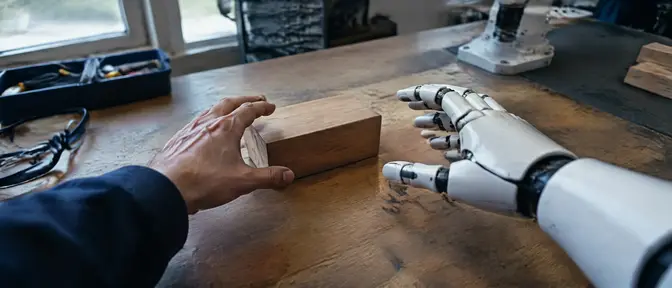
A robot operator runs robots for a living, and the job comes in three forms. Factory robot operators run welding or production cells: Lincoln Electric lists $22.58 to $28.85 an hour and Ventrac $22 to $27. Humanoid robot operators test robots on-site: Figure lists $26 to $30. Teleoperation and data collection operators control robots to create AI training data: Figure lists $32 an hour for a robot pilot and 1X $28 to $36.
- Factory robot operator jobs are steady manufacturing work, often in welding cells, at about $22 to $29 an hour in the listings we read.
- Humanoid robot operator and pilot jobs are newer, mostly in California, and pay about $26 to $36 an hour in Figure and 1X listings.
- Teleoperation means controlling a robot remotely, often in VR, so it can learn from your movements. Some delivery robot teleoperation is remote from home.
- Many of the new roles are contract-to-hire or fixed-term, physical (stand 8+ hours, lift up to 50 lbs) and may require travel.
- Robot data collection jobs are few. Check the employer's own careers page and never pay to apply.
What are robot operator jobs?
A robot operator is someone who runs, watches or controls robots as their main job. The title now covers three kinds of work that pay and feel very different.
Factory robot operators load parts, start and monitor robot cells such as welding robots, check quality and fix small faults. These are manufacturing jobs, usually full-time with benefits.
Humanoid robot operators work for robotics companies, running new robots on test floors or customer sites, logging bugs and keeping the robot working.
Teleoperation and data collection operators control a robot directly, often wearing a VR headset and hand controllers, so the robot can learn from what they do. The recordings become teleoperation data for training AI. A few remote roles let you guide delivery robots from home.
Origin has not worked in these roles; this page reports what each employer's own listing said on 12 November 2026. Listings close and reopen often.
How much do robot operators make?
Pay below is the base range each employer posted. Benefits, bonuses and shift premiums are on top where the listing says so.
| Role | Employer | Stated pay | Where | Terms |
|---|---|---|---|---|
| Additive robotic welding cell operator | Lincoln Electric | $22.58 to $28.85/hr, 8% target bonus | Euclid, Ohio | Hourly full-time |
| Robotic welder (2nd shift) | Ventrac (The Toro Company) | $22 to $27/hr to start | Orrville, Ohio | $2,000 sign-on bonus |
| Humanoid robot operator (commercial site) | Figure | $26 to $30/hr | Los Angeles | Contract-to-hire; driver's license |
| Humanoid robot operator (morning shift) | Figure | $30/hr | San Jose, CA | Contract-to-hire |
| Humanoid robot pilot (teleoperation) | Figure | $32/hr | San Jose, CA | 6-month fixed term; travel |
| Operator, data collection (swing shift) | 1X | $28 to $36/hr | San Carlos, CA | Full time, on-site |
| Delivery robot teleoperator | RoboPilots | Not stated | Remote, listed countries | Paid training |
Sources for this table: Figure: Humanoid Robot Operator, Commercial Site Team (LA), read 12 Nov 2026; Figure: Humanoid Robot Operator (Morning Shift), read 12 Nov 2026; Figure: Humanoid Robot Pilot, read 12 Nov 2026; 1X: Operator, Data Collection (Swing Shift), read 12 Nov 2026; RoboPilots: Delivery Robot Teleoperator, read 12 Nov 2026.
Factory robot operator jobs
Most "robot operator" listings are in manufacturing. Lincoln Electric is hiring an Additive Robotic Welding Production Cell Operator in Euclid, Ohio, at $22.58 to $28.85 an hour with an 8% target bonus. Ventrac, a division of The Toro Company, hires second-shift robotic welders who operate a welding robot or weld by hand, at $22 to $27 an hour to start, with a $2,000 sign-on bonus.
These jobs reward reliability, reading drawings and basic mechanical skill more than any robotics degree. They are the most common and most stable kind of robot operator work, but they are about producing parts, not training AI.
Humanoid robot operator and robot pilot jobs
Figure, which builds humanoid robots, lists Humanoid Robot Operator roles at $30 an hour in San Jose and $26 to $30 an hour on its Los Angeles commercial site team, both contract-to-hire. Operators run the robot through the day, find bugs and file them in Jira, and must be able to lift up to 50 lbs; the LA role also needs a valid driver's license. Sources: Figure: Humanoid Robot Operator (Morning Shift), read 12 Nov 2026; Figure: Humanoid Robot Operator, Commercial Site Team (LA), read 12 Nov 2026.
Its Humanoid Robot Pilot role is the teleoperation job: you wear teleoperation equipment and guide the robot through set behaviors to collect training data. It pays $32 an hour as a six-month fixed-term position, with varying shifts and travel that can include offsite stays of up to one month. Source: Figure: Humanoid Robot Pilot, read 12 Nov 2026.
1X, which builds the NEO home robot, lists an Operator role on its data collection team in San Carlos at $28 to $36 an hour. Operators run humanoid robots in lab and home-style settings, annotate the data, work comfortably in VR, and must lift up to 50 lbs and wear equipment of up to 30 lbs. (The listing loads with JavaScript; 1X's public job board feed shows the same range.) Source: 1X: Operator, Data Collection (Swing Shift), read 12 Nov 2026.
Remote teleoperation and robot data collection jobs
A small number of teleoperation roles are remote. RoboPilots recruits delivery robot teleoperators who guide sidewalk and road delivery robots from a remote console at home, with paid training and no prior robotics experience required. It does not state pay, and it asks for a private workspace because sessions can show the inside of a client site or a home. Source: RoboPilots: Delivery Robot Teleoperator, read 12 Nov 2026.
Tesla's Optimus data collection operator role is on-site and physical; see Tesla data collection operator for its pay and requirements. Roles centered on wearing motion sensors rather than controlling a robot are in motion capture jobs.
Robot data collection jobs that you can do without a robot are more common: you film your own hands doing tasks. See apps that pay you to record chores and get paid to wear a camera at work.
What equipment and skills do you need?
For on-site jobs the employer supplies the robot and the teleoperation gear. You supply stamina, focus and reliability.
- Physical: Figure's operator roles ask you to stand 8+ hours and lift up to 50 lbs; 1X asks you to lift 50 lbs and wear up to 30 lbs of equipment.
- VR comfort: teleoperation roles at 1X and Figure involve headsets and controllers. If you get motion sickness, test this before you commit.
- Remote teleoperation: a stable wired or strong Wi-Fi connection, a recent computer with a large screen and a quiet private room, per RoboPilots.
- Helpful background: gaming, driving, dispatch, mechanical repair or factory work. Most listings do not ask for a degree.
Privacy and consent: homes, customers and cameras
Robots record everything around them. As an operator you see what the robot sees.
- Homes and customer sites: teleoperators may see inside homes and businesses. Treat it as confidential, and never record or share your screen.
- Other people: on test floors and sites, colleagues and customers may be on camera. Follow the employer's rules on who can be filmed and when to pause.
- Minors: home robot programs may operate where children live. Ask how the employer handles that before you start.
- Your current employer: check your contract allows outside work before taking a second job.
How does payment work?
These are hourly jobs paid through payroll: as an employee, or as a contractor on a contract-to-hire or fixed-term basis. That is different from data apps, which pay per accepted file after review. Check whether benefits apply during the contract period; Figure says the total package may include more and is shared with an offer.
If you run a business whose staff do hands-on work, your business can be paid for recordings of that work instead: check whether your business qualifies, or see business video programs compared.
How do you check a program before you send files?
Programs in this field open and close quickly, and new names appear every month. Run the same checks on each one before you upload anything or spend hours on it.
- Never pay to join. Real data programs pay you; they do not charge a sign-up, training or "kit" fee.
- Find the company behind it: a legal name, an address and a contact who answers. An app store listing shows the developer's name.
- Read the terms for who owns your files, what they may be used for, and whether you can ask for them to be deleted.
- Look for the rate per accepted item or hour, the payout method, the payout minimum and how long review takes. If any of these are missing, ask in writing.
- Start small. Send a short first batch and wait for the money to arrive before you do more.
- Keep copies of what you submitted, every consent form, and every message about pay.
- Apply through the employer's own careers page. Be wary of anyone asking for payment, bank details or ID before an interview.
- Ask whether a role is contract-to-hire or fixed-term, and what happens when the term ends.
Origin's reviews of recording programs
If you want to earn from robot training without a full-time job, these reviews cover the programs that pay for recordings. The wider map is in AI data collection jobs.
- Video of chores and everyday tasks: Claru AI review, Hub Data review, Taskverse review, Contracted AI review, Human Archive review, HighFive app review and Amelia Chores review.
- Trust checks: is Loggy3 legit?, is Atlas Capture legit?, is Amelia Robotics legit? and the Shift app review.
- Lists and rates: apps that pay you to record chores, get paid to wear a camera at work, get paid to record your voice for AI, the pay rates tracker and DoorDash Tasks.
What we checked (12 Nov 2026)
We opened each employer's own job listing and copied the posted pay, location and requirements. We did not apply for these roles.
- Factory: Lincoln Electric (Additive Robotic Welding Production Cell Operator) and Ventrac, a division of The Toro Company (2nd shift robotic welder).
- Humanoid and teleoperation: Figure (Humanoid Robot Operator in San Jose and Los Angeles, Humanoid Robot Pilot), 1X (Operator, Data Collection; the page renders with JavaScript, so we also read 1X's public job board feed) and RoboPilots (Delivery Robot Teleoperator).
Next step
Pick the kind of robot operator job you want and check the employers' careers pages each week; humanoid roles open in batches. Tell us what you do. We'll send you the paid AI work that fits your field, wherever you live. It's free.
Common questions
How much does a robot operator make?
It depends on the kind of job. Factory robot cell listings we read pay $22 to $28.85 an hour (Lincoln Electric, Ventrac). Humanoid robot operator and pilot roles pay $26 to $36 an hour (Figure, 1X).
What is a robot teleoperator?
A person who controls a robot remotely, often with a VR headset and hand controllers, so it completes a task and records data the robot can learn from. Figure's Humanoid Robot Pilot role pays $32 an hour.
Are there remote robot operator jobs?
A few. RoboPilots recruits remote delivery robot teleoperators with paid training in listed countries, but does not state pay. Most humanoid robot roles are on-site in California.
What are robot data collection jobs?
Jobs that create training data for robots: operating a robot by teleoperation (1X lists $28 to $36 an hour), wearing motion sensors, or filming your own tasks for apps that pay per accepted hour of video.
Do you need a degree to be a robot operator?
The listings we read do not ask for one. They ask for physical stamina, focus, comfort with VR for teleoperation, and sometimes experience troubleshooting machines.
What about the Tesla data collection operator job?
It is an on-site, physical role that records movements to train the Optimus robot. Origin's Tesla data collection operator page covers its pay and requirements.
What does a data collection operator do?
A data collection operator runs robots, or performs tasks, so the session produces AI training data, then labels it. 1X's listing for an Operator on its data collection team in San Carlos, California, checked 14 November 2026, describes operating humanoid robots in lab and home-style settings, annotating the data and working in VR, at $28 to $36 an hour.
Sources and further reading
- Lincoln Electric: Additive Robotic Welding Production Cell Operator
- Ventrac (The Toro Company): 2nd shift robotic welder
- Figure: Humanoid Robot Operator (Morning Shift)
- Figure: Humanoid Robot Operator, Commercial Site Team (LA)
- Figure: Humanoid Robot Pilot
- 1X: Operator, Data Collection (Swing Shift)
- 1X: public job board feed
- RoboPilots: Delivery Robot Teleoperator
Origin Data Partners is independent and does not represent Amelia Robotics. Origin may earn a reward from Amelia Robotics if a business it introduced joins and gets paid; Amelia pays that reward itself. Origin charges your business nothing. How Origin is paid.