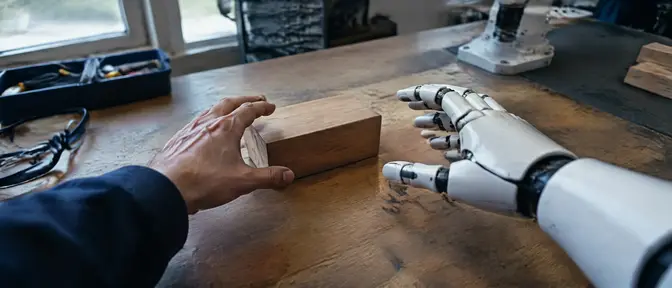
Yes. Several new programs pay workers to wear a phone or camera during their normal job so robots can learn the work. HUMXN and eeko systems state $20 per accepted hour for US tradespeople, 7th Unit states $15 per usable hour for warehouse and factory staff, and 1618 Robotics states USD 2.50 to 9. Most are new, few publish who they are, and only accepted footage is paid. You also need permission: from your employer, from customers whose homes or sites you work in, and, for audio in some places, from everyone recorded.
- Stated rates run from USD 2.50 to 9 per accepted hour (1618 Robotics) to $20 (HUMXN, eeko systems, FieldPOV) and project listings of $35 to $60 an hour (Treky). Only accepted footage is paid.
- Most programs are US only or open country by country. Curatrix and EgoVista work in Europe and TrainAR in the UK.
- Every program we checked asks for permission from whoever runs the site: your employer, or the customer whose home you work in.
- Recording sound is the legal risk. US federal law allows one-party consent, but California and other states require everyone's consent.
- If you are employed, the simplest route is often for your employer to join a business program for the whole crew. check whether your business qualifies.
Can you get paid to wear a camera at work?
Yes. Robotics companies need first-person video of real hands doing real jobs, and a growing number of programs now pay workers to record their own shifts. You wear a phone or small camera on your head or chest, do the job as usual, and upload the footage. A reviewer checks it, and you are paid for the hours that pass.
The pay is on top of your normal job, not a wage. Most programs are new, publish little about who runs them, and pay only for accepted footage. Several sites use almost the same wording as each other. Treat every rate below as a claim until a first payout arrives. Origin has not used any of these programs; this page reports what each program's own site says on 11 Nov 2026.
If you are an employee, there is a second route: your employer joins a business program and the whole crew records. That route is covered in business video programs compared.
Which companies pay workers and tradespeople to record their jobs?
"Stated pay" is the figure on the program's own page. "Not stated" means we found no figure. Rates are per accepted or usable hour unless marked.
| Program | Who it takes | Stated pay | Where | What to know |
|---|---|---|---|---|
| HUMXN | Plumbers, electricians, HVAC and other trades | $20 per accepted hour | US | Your own camera; customer or employer must agree in writing |
| eeko systems | Skilled trades | $20 per accepted hour | US | Same terms as HUMXN in almost the same words |
| micro1 (trade skills) | Plumbers and other trades | $20 to $30 an hour (plumber opening) | Not stated | Paid every two weeks for approved work |
| Treky | Electricians, welders, HVAC, machinists, warehouse | $35 to $60 an hour (electrician project) | Not stated | Kit supplied; paid weekly per accepted hour or session |
| 7th Unit | Warehouse and factory workers | $15 per usable hour | Not stated | Your phone; it builds warehouse robots |
| World Data Co | Workers in 16 industries | $10 to $30 an hour | Not stated | Camera shipped free; payout claims not verifiable |
| FieldPOV | Tradespeople | $20 per usable hour (its calculator) | US only | Waitlist; final rate set per task |
| 1618 Robotics | Workers and people at home, 19 and over | USD 2.50 to 9 per accepted hour | Opening country by country | At least 10 hours a week; written permission at work |
| Curatrix | Qualified tradespeople | Shown before you record | Germany | Paid monthly; signed customer form needed |
| TrainAR | UK plumbing, heating, gas, electrical, locks | Monthly share of bundle sales | UK | Closed for now; waiting list |
| EgoVista | Anyone, at home or in a trade | Per mission, shown before you join | Missions by country (France-based) | Paid by bank transfer after review |
| Firsthand | Individuals and teams | Not stated | 14 countries | One US project excludes CO, IL, TX and WA |
| AV Data (professionals) | Workplace professionals | Per approved minute; not stated | Worldwide except the EU | Workplaces only; $20 minimum cash-out |
| Lifted (an Upwork company) | Business owners, or staff with the owner's documented consent | Hourly per usable video; not stated | Not stated | Commercial sites only, no home tasks |
Sources for this table: micro1: get paid to record tasks (trade skills), read 11 Nov 2026; Job listing: Lifted (an Upwork company), read 11 Nov 2026.
What do these programs say about pay and payment?
HUMXN says it pays $20 for every hour of footage that passes review, through Stripe, for trades anywhere in the United States, and that you record on your own phone or action camera. eeko systems offers the same $20 rate and US coverage and adds that footage without a matching signed form is not reviewed, not paid, and deleted.
micro1 lists a plumber opening at $20 to $30 an hour and pays every two weeks for approved work. Treky lists project rates such as $35 to $60 an hour for residential electricians, ships a capture kit and pays weekly. 7th Unit pays $15 per usable hour for warehouse and factory work and says most people are paid within 1 to 3 business days. World Data Co states $10 to $30 an hour and says it has paid out over $425,000; we could not check that figure or the testimonials on its site. Source: micro1: get paid to record tasks (trade skills), read 11 Nov 2026.
1618 Robotics, run by a company in Geneva, pays USD 2.50 to 9 per accepted hour, asks for at least 10 hours a week and opens country by country. In Europe, Curatrix shows the rate for your trade before you record and pays monthly, and EgoVista shows a rate on each mission. In the UK, TrainAR pays curators a share of sales but says the program is full right now.
Others we found do not publish pay. Trades Data AI is a private pilot of safety glasses with a camera. Embodex and Tradeye work with trade crews but list no pay for outside workers. Shift also runs a UK site, but its details only load in a browser, so see our Shift app review for its published terms.
What do these programs require before you record?
The rules are similar across programs. Expect all of these before your first paid hour.
- Gear: usually your own recent phone and a head or chest mount. Some ship a kit, such as Treky and World Data Co.
- Employer permission: 1618 Robotics asks for written permission from the person in charge of the place, Curatrix reviews employer and site permissions before capture, and eeko systems has the contractor sign once for the whole crew.
- Customers' homes and sites: HUMXN says nothing is recorded on a customer's site until the customer agrees, and Curatrix films nothing on a customer's property without a signed form. If a customer says no, skip that job.
- Faces and documents: programs such as HUMXN and Treky say faces and identifying details are removed. Still keep mail, screens, paperwork, children and house numbers out of frame.
- Pausing: stop recording for breaks, phone calls, conversations and anything private. Unrecorded time is simply not paid.
- Taxes: this is extra income. Curatrix, for example, says it withholds nothing and files nothing on your behalf, so keep records.
Are these programs legit?
Some are run by known companies, such as micro1. Many are new sites with no press coverage, no public owners and no payment record we could check. Two of them, HUMXN and eeko systems, describe the same terms in almost the same words. That does not make them fake, but it means you are trusting a claim.
Protect yourself the same way with each one: never pay a fee to join, record a short first session and wait for the money to arrive before you invest many hours, read the participation agreement for who owns the footage, and keep copies of every consent form you hand to a customer or employer.
Can you, or your employees, record at work?
This is general information, not legal advice. Laws change and depend on where you work, so ask your employer and, where needed, a lawyer.
In plain terms, three permissions matter. First, your employer: workplaces set their own rules on cameras, and recording without permission can break those rules. Second, the site: a customer's home, a building manager or a general contractor decides what can be filmed there. Third, the people in the recording, especially if sound is recorded.
Video of your own hands is usually less sensitive than sound. Conversations are what most recording laws protect, which is why many programs ask you to pause for talk, and some record no audio at all. Others, such as micro1's business program, require audio to stay on, so check before you start.
Is it legal to record audio at work in the US?
US federal law, 18 U.S.C. 2511, allows recording where the person recording is a party to the conversation or one party has given prior consent. States can be stricter. California's Penal Code section 632 makes it an offence to record a confidential communication without the consent of all parties.
The Digital Media Law Project says eleven states require every party's consent and lists California, Connecticut, Florida, Illinois, Maryland, Massachusetts, Montana, New Hampshire, Pennsylvania and Washington. Its advice is that it never hurts to get the consent of everyone you intend to record. For a camera that runs during a service call, that means telling the customer and anyone else nearby, or switching sound off.
Source: Cornell LII: 18 U.S.C. 2511
What are the rules in the UK, Canada, Australia and India?
These official sources are written mainly for employers who monitor staff. Recording for an AI company is a different purpose, but the same principles of notice, fairness and consent apply.
- UK: the ICO says employers should only monitor workers in ways they would reasonably expect, must make sure workers are aware of what is collected, and are unlikely to justify covert monitoring. Before video or audio monitoring, an employer must complete a DPIA (a data protection impact assessment).
- Canada: the Office of the Privacy Commissioner says individuals have a right to privacy at work, even on the employer's premises, that employers must limit collection to what is necessary, and that several provinces have their own laws.
- Australia (New South Wales): under the Workplace Surveillance Act 2005, surveillance may only occur after written notice to the employee at least 14 days before it starts, or less if the employee agrees. Rules differ by state, so check the law where you work.
- India: the Digital Personal Data Protection Act, 2023 says consent must be free, specific, informed, unconditional and unambiguous with a clear affirmative action. It also lists employment purposes as a legitimate use. Ask a lawyer which parts apply to recording for an outside company.
Can I wear a body camera or Meta glasses at work?
Treat it as your employer's decision. Workplaces set their own rules on cameras for their premises, customers and confidential work, and a customer can refuse filming in their home. Camera glasses, such as the Meta glasses many people ask about, are still cameras: if they capture video or sound, the same employer rules and the same audio consent laws above apply.
If you want to record for one of these programs, ask first, in writing, and get the answer in writing. Some programs accept smart glasses, such as EgoVista; others ask for a phone on a head or chest mount, so check the program's gear rules before you buy anything.
How do you ask your employer for permission?
Keep it short and specific, and offer the safeguards before they ask. A request that covers these points is easier to approve:
- Which program, what it pays and a link to its site.
- What the camera sees: your hands and tools, not customers, screens or paperwork.
- When it runs: only during named tasks, paused for conversations, breaks and private areas.
- Whether sound is recorded, and how customers will be asked first.
- Who receives the footage and whether faces and documents are removed.
- An offer to stop at any time if the business or a customer objects.
- That the business itself could be paid instead, if it joins a business program for the whole crew.
Run a crew or own the business? Your team can join together
Your boss can sign up the whole team. Several programs pay the business, not each worker, for approved footage of the crew's normal work, and the owner decides how much to share. Mercor states $12 to $18 per approved hour to the business, Hub states US$5 to 10, and Amelia Robotics gives an example of about $10 per approved hour. check whether your business qualifies, or compare every option in business video programs compared.
Origin may be paid by Amelia Robotics when a business it introduces is paid. That is why we list the other programs, with their rates, next to Amelia. If your business also keeps job files, estimates or work orders, see what your company records are worth.
What we checked (11 Nov 2026)
We opened each program's own page and copied its stated rate, countries, payment schedule and permission rules. Where a page was silent we wrote "not stated". We did not sign up, record or receive any payment.
- Program pages: HUMXN, eeko systems, micro1 (trade skills and business), Treky, 7th Unit, World Data Co (Record Your Day), FieldPOV, 1618 Robotics, Curatrix, TrainAR, EgoVista, Firsthand, AV Data, Lifted's job posting, Trades Data AI, Embodex, Tradeye and Shift UK.
- Left out: Curbily, whose pages need a browser to load and showed no readable terms, and the micro1 job board, which also needs a browser. Mercor's robotics page is for businesses, so it is in the business comparison, not here.
- Law and regulators: 18 U.S.C. 2511 (Cornell LII), California Penal Code 632, the Digital Media Law Project's recording guide, the UK ICO's guidance on monitoring workers, Canada's Office of the Privacy Commissioner, the NSW Government's circular on the Workplace Surveillance Act 2005, and India's Digital Personal Data Protection Act, 2023.
If you own the business: the consent rules by state
Owners who want the whole crew to record should read recording employees at work: consent and notice rules by state, which sets out the all-party consent statutes, the written-notice laws in Connecticut, New York and Delaware, and what programmes ask of the business.
Next step
If you work on a crew, share how businesses get paid for recording work with your employer. If you work alone, start with one program from the table and confirm a small payout first.
Common questions
Can I get paid to wear a camera at work?
Yes. Programs such as HUMXN, eeko systems, 7th Unit and 1618 Robotics pay workers for accepted first-person footage of their normal job. Stated rates run from USD 2.50 to 9 to $20 per accepted hour, and you need permission from your employer and any customer whose site you work on.
Which companies pay tradespeople to record their jobs?
HUMXN and eeko systems state $20 per accepted hour for US trades, micro1 lists a plumber opening at $20 to $30 an hour, Treky lists projects from $22 to $65 an hour, and FieldPOV uses $20 per usable hour. Curatrix (Germany) and TrainAR (UK) work in Europe. Most are new, so confirm a payout first.
Can I wear a body camera at work?
Only with your employer's permission. Employers can ban cameras on their premises, and recording sound can need everyone's consent in some places, such as California. Ask in writing and keep the answer.
Can I wear Meta glasses at work?
Smart glasses count as a camera, so the same rules apply: your employer must allow it, customers should agree before you record on their site, and audio laws apply if sound is captured. Some recording programs accept glasses, others ask for a phone mount.
Do I need my employer's permission to record my work for AI training?
Yes, in practice. Programs such as 1618 Robotics, Curatrix and eeko systems ask for written permission from whoever runs the workplace, and HUMXN only accepts footage the customer or employer agreed to in writing.
Do customers have to agree before I record in their home?
The programs we checked require it. HUMXN records nothing on a customer's site until the customer agrees, and Curatrix films nothing on a customer's property without a signed form. If a customer says no, skip that job.
Is it legal to record audio at work?
It depends where you are. US federal law allows recording with one party's consent, but California and other states require all parties to agree. In the UK, Canada, Australia and India, notice and consent rules also apply. This is general information, not legal advice.
Can my boss sign up the whole crew instead?
Yes. Business programs such as Mercor, Hub and Amelia Robotics pay the business for its crew's approved footage, and the owner decides each worker's share. Origin may be paid by Amelia when a business it introduces is paid.
Sources and further reading
- HUMXN: AI training jobs for skilled trades
- eeko systems: AI training jobs for skilled trades
- micro1: get paid to record tasks (trade skills)
- Treky: contribute data
- 7th Unit: data collection program
- 1618 Robotics: record the work you already do
- Curatrix: paid recording work for tradespeople
- Cornell LII: 18 U.S.C. 2511
- California Penal Code section 632
- Digital Media Law Project: recording phone calls and conversations
- ICO: data protection and monitoring workers
- Office of the Privacy Commissioner of Canada: privacy in the workplace
- NSW Government: Workplace Surveillance Act 2005 circular
- India: Digital Personal Data Protection Act, 2023 (MeitY)
Origin Data Partners is independent and does not represent Amelia Robotics. Origin may earn a reward from Amelia Robotics if a business it introduced joins and gets paid; Amelia pays that reward itself. Origin charges your business nothing. How Origin is paid.