In 2026, construction robots do narrow, repetitive jobs on big commercial and solar sites, not whole trades. Built Robotics runs autonomous pile drivers on solar farms, Dusty Robotics prints layout onto slabs (over 91 million square feet with its first model), and Canvas uses a human-operated robot to tape, mud and sand drywall. For most contractors the bigger 2026 issue is labor: ABC says the industry must attract 349,000 net new workers this year.
- Real construction robots handle one repeatable task on a structured part of the site: piles in rows, lines on a flat slab, finish on a flat wall.
- The industry is short of people, not overrun by robots. ABC estimates 349,000 net new workers are needed in 2026 and 456,000 in 2027.
- Robot makers still struggle with messy, changing sites, which is why they want first-person video of real crews doing real work.
What are robots actually doing on construction sites in 2026?
Search "construction robots" and most results are vendor pages selling a machine. Here is the owner's view. The robots that are working on US jobs today each do one task that repeats in a predictable space. A pile driver on a solar farm drives the same steel post in long straight rows. A layout printer drives across a finished slab and prints the lines every trade will build to. A drywall robot sprays and sands flat walls while a person runs it.
Built Robotics says leading contractors use its pile-driving robots across the US and Australia, running in coordinated fleets up to 24 hours a day. Dusty Robotics says its first-generation FieldPrinter printed over 91 million square feet of layout before its second model launched. Canvas's drywall machine is operated by people and, on one job reported by Construction Dive, cut a seven-day finishing job to two.
| Company | Robot and task | Status | Source |
|---|---|---|---|
| Built Robotics | RPD 35 autonomous pile driver for utility-scale solar | Deployed (US and Australia) | Built Robotics |
| Dusty Robotics | FieldPrinter prints building layout on the slab from the plans | Deployed | PR Newswire |
| Canvas | Drywall taping, mud spraying and sanding, run by an operator | Deployed on commercial jobs | Construction Dive |
| Various humanoid makers | General-purpose site tasks | Pilots and research; IFR says most need human teleoperation | IFR |
How much does a construction robot cost?
None of the three makers above lists a price on the pages we checked, so treat any number you see online with care. In practice a contractor rarely buys one outright. You hire the output: a crew and machine priced per pile, per square foot of layout or per wall area, the same way you would price a subcontractor. Across robotics more broadly, the International Federation of Robotics says robots-as-a-service, a monthly or usage fee instead of a purchase, is already the dominant business model for logistics robots in the US.
For a small contractor the practical question is not "should I buy a robot" but "would a sub with a robot beat my current price and schedule on this job". Ask for references on a job like yours, the human crew it still needs, and who carries the risk if the machine is down.
How many construction companies use robots?
There is no reliable count of robots on US construction sites. What is well measured is the labor gap that robots are meant to help with. Associated Builders and Contractors estimates the industry needs 349,000 net new workers in 2026 and 456,000 in 2027. In the AGC 2025 Workforce Survey, 83 percent of firms with craft openings said those jobs were as hard or harder to fill than a year earlier.
The Bureau of Labor Statistics projects about 137,000 openings a year for construction laborers and helpers, with employment growing 6 percent from 2025 to 2035. Robots are arriving into a short-handed industry, not a crowded one.
What can construction robots still not do?
A building site changes every day. Materials move, other trades are in the way, nothing is quite where the drawing says, and most work needs two hands that adjust by feel. That is exactly where today's robots fail. Notice that every working example above sticks to a structured surface: open ground in rows, a clean slab, a flat wall.
General-purpose humanoids are not ready to fill the gap. The IFR said in September 2026 that most humanoid applications remain specialized and often require human teleoperation, and that safety standards, training and maintenance costs and the lack of a strong business case still limit adoption. Framing in a crawlspace, pulling wire through a finished wall or setting a tub are years away from being done by a machine on its own.
Will robots replace construction workers?
Not in the next few years, and not for most trades. The honest picture is that robots take over slices of work that are repetitive, physically punishing and easy to measure, such as driving piles, marking layout and sanding. The people on those jobs move to setup, checking and the many tasks the machine cannot do. Contractors still compete for workers: AGC found 95 percent of firms raised base pay in the past year.
For owners, the useful moves are the same as before robots: pay competitively, train, and keep good people. See our page on the skilled trades shortage for what contractors are doing to keep crews.
Why robot makers need footage of your crew
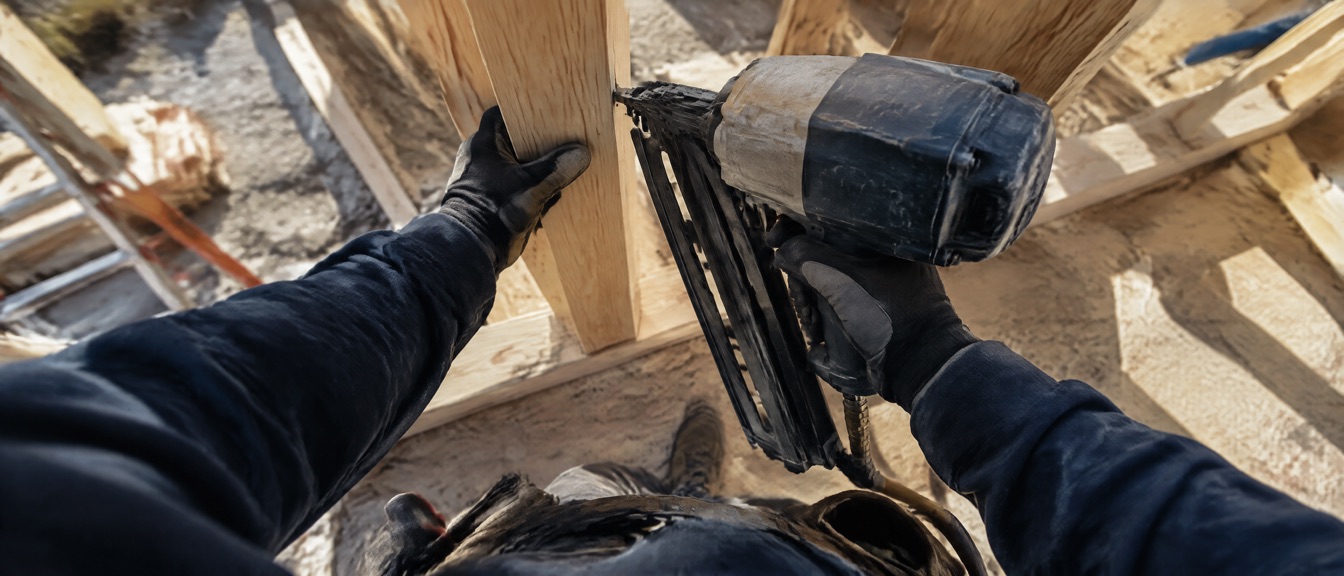
The hard part for robot makers is teaching a machine how skilled people handle messy, real work. One answer is first-person video. Figure, a humanoid maker, said it trained its Helix model to navigate homes using 100% egocentric human video and no robot demonstrations. Labs want the same kind of footage from real job sites. Our explainer on how robots learn from video covers why.
Amelia Robotics pays businesses for approved recordings of work their crews already do. A phone is mounted so it films the task from the worker's view with the hands in frame, and each worker starts a recording deliberately. Tasks, permitted areas and participants are agreed on a setup call before anyone records, and you can leave out jobs or areas. Payment goes to the business once a month with a statement, and you decide how much to share with the crew.
Illustrative example: a contractor with 6 crew members who each record 15 approved hours a week would earn about $3,600 a month at the typical rate (6 x 15 x 4 x $10). Amelia's typical pay is $500 to $2,000 a month per recording employee, assuming 12.5 to 50 approved hours a week. Earnings vary, and your agreement and approved recordings decide actual pay. See what counts on our construction businesses page.
Next step
Start with how construction and trade businesses get paid for recording work, where the calculator shows an estimate for your crew size.
Common questions
Will robots replace construction workers?
Not soon. Working construction robots handle single repetitive tasks such as pile driving, layout printing and drywall finishing, while ABC says the industry still needs 349,000 net new workers in 2026.
What robots are used in construction today?
Examples in real use include Built Robotics' autonomous solar pile drivers, Dusty Robotics' layout printers and Canvas's human-operated drywall finishing robot. General-purpose humanoids are still in pilots.
How much does a construction robot cost?
The makers we checked do not publish list prices. Contractors usually pay for the output, priced per pile, per square foot or per job, rather than buying the machine.
What construction tasks can robots not do yet?
Anything in a cluttered, changing space that needs two hands adjusting by feel, such as rough-in plumbing, pulling wire or framing tight spaces. The IFR says most humanoids still need human teleoperation.
Can a construction company get paid to help train robots?
Yes. Amelia Robotics pays businesses for approved first-person recordings of work crews already do. Typical pay is $500 to $2,000 a month per recording employee, and earnings vary.
How many construction workers are needed in 2026?
Associated Builders and Contractors estimates 349,000 net new workers in 2026 and 456,000 in 2027.
Sources and further reading
- Built Robotics: solar piling robots
- Dusty Robotics: second-generation FieldPrint platform
- Construction Dive: Canvas drywall finishing robot
- IFR: World Robotics 2026 service robots (Sep 2026)
- ABC: construction must attract 349,000 workers in 2026
- AGC: 2025 Workforce Survey analysis (PDF)
- BLS Occupational Outlook: construction laborers and helpers
- Figure: Project Go-Big, training on human video
- Amelia Robotics: business program (checked Nov 2026)
- Amelia Robotics: for robotics labs
Origin Data Partners is independent. We may be paid by our partner when a business we introduce is paid; it never comes out of your earnings. How Origin is paid.