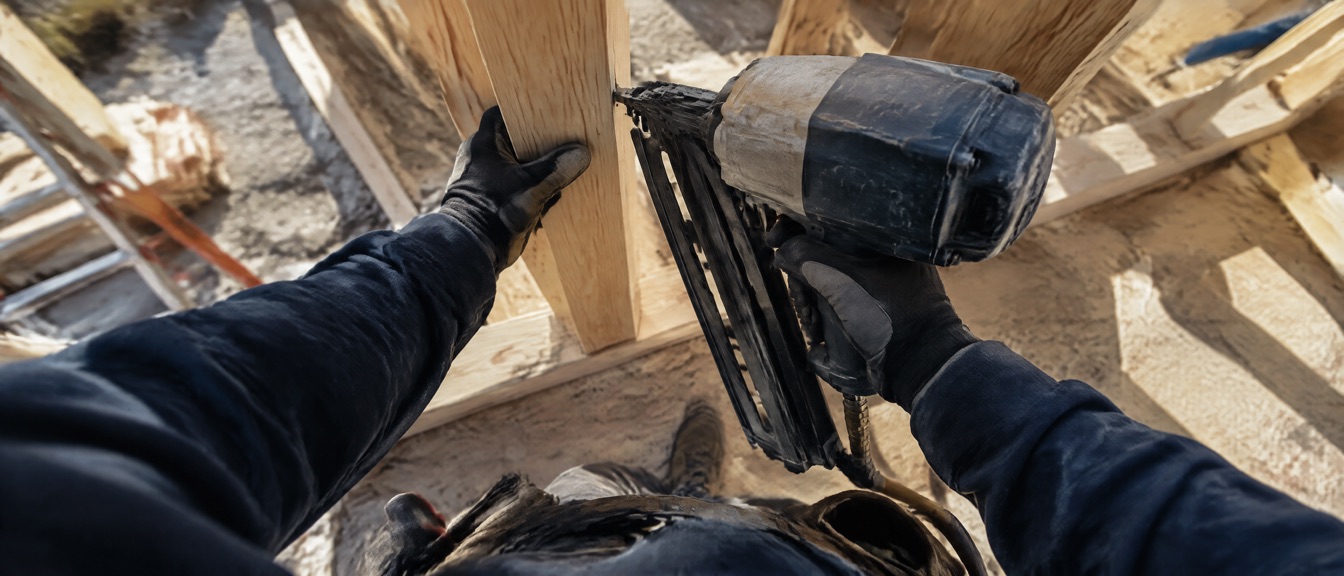
Yes. Amelia Robotics pays construction businesses for approved recordings of work their crews already do, such as framing, roofing, flooring, drywall and site cleanup. Typical pay is $500 to $2,000 a month per recording employee, assuming 12.5 to 50 approved hours a week, and earnings vary. Payment goes to the company monthly; you set the crew shares.
- Construction is one of Amelia's top priorities, with six published task examples from framing to hardware installation.
- On site, the mount has to work with hard hats and other PPE. Never modify a helmet to carry a phone.
- Residential jobs can count, but get the homeowner's and the general contractor's OK first.
Do AI and robotics companies pay construction companies for video of their crews?
Some do, and Amelia Robotics runs a program built for it. Your crew records the work they are already doing with a phone mounted to capture their view, hands in frame. Amelia pays the business once a month for approved recordings, with a statement showing hours and shares. Typical pay is $500 to $2,000 a month per recording employee at 12.5 to 50 approved hours a week. Earnings vary, and your agreement and the approved recordings set the real number.
Construction suits this well because almost every hour on site is hands-on. See the physical AI hub for how the program compares with other ways to get paid for footage.
Source: Amelia Robotics: business program (checked Nov 2026)
Which construction tasks count?
Amelia publishes six construction examples. Between them they cover most trades on a typical residential or light commercial build:
- Framing: layout, cutting studs and plates, nailing walls and raising them.
- Roofing: tear-off, underlayment, shingle and flashing work.
- Flooring: subfloor prep, plank, tile and sheet goods.
- Site cleanup and debris removal.
- Drywall and insulation installation: hanging, taping, mudding, batts and blown-in.
- Painting and hardware installation: cutting in, rolling, doors, hinges, handles and trim hardware.
Source: Amelia Robotics: business program (checked Nov 2026)
What could your crew earn?
Move the sliders to match your crew.
- Per worker
- $500
- You keep
- $5,000
- Per year
- $120,000
Illustrative, at about $10 per approved hour. Typical pay is $500 to $2,000 a month per recording employee; earnings vary and your agreement decides actual pay.
How much could a construction crew earn from recordings?
Illustrative maths at the typical rate of $10 per approved hour (people x approved hours a week x 4). Crews that spend most of the day on tools can reach the higher hour bands, but weather days, inspections and material waits all cut approved hours, so plan on the lower end at first.
Amelia's split example is worker 50%, team lead 10%, business 40%. A foreman bonus through the lead share is an easy way to make sure someone on each crew keeps the cameras charged and the footage on task.
| Example crew | People recording | Approved hours a week each | Illustrative monthly payment | Business keeps (40% example) |
|---|---|---|---|---|
| Framing or drywall crew | 5 | 20 | $4,000 | $1,600 |
| Builder with two crews | 12 | 25 | $12,000 | $4,800 |
| Specialty subcontractor | 25 | 30 | $30,000 | $12,000 |
Is it safe to wear a phone on a hard hat, and what about OSHA?
OSHA requires protective helmets wherever there is a danger of head injury from impact, falling or flying objects, or electrical shock and burns (29 CFR 1926.100). A camera does not change that duty. Use a mount that clips or straps to the helmet without drilling, and check that the helmet maker allows the accessory. If a mount cannot sit securely with the PPE a task needs, such as a face shield or respirator, leave that task out.
Roofing and work at height need extra thought. A phone that can slip is a falling-object hazard to people below. Agree on the setup call whether roof work is in scope and how the phone is secured. Saws, nail guns and grinders should never be paused or used differently for the camera.
Source: 29 CFR 1926.100: Head protection (OSHA construction standard)
Whose permission do you need on a construction site?
Your own workers first: get written agreement from everyone who records. Some states also set rules for watching staff electronically. Connecticut, for example, requires prior written notice to employees and counts cameras as electronic monitoring (Conn. Gen. Stat. sec. 31-48d). On someone else's site, the general contractor or owner may have photography rules, so ask before the first recording. On residential jobs the homeowner should agree, especially for interior work. If the phone picks up conversations, remember the all-party consent states. About 11 states, including California, Florida, Illinois, Pennsylvania and Washington, require everyone in a conversation to agree before it is recorded (Reporters Committee for Freedom of the Press).
- Keep plans, permit documents and client names out of frame.
- Avoid recording other trades' workers who have not agreed.
- Agree which sites are excluded, such as government or secure facilities.
Source: Reporters Committee for Freedom of the Press: Reporter's Recording Guide
Why do robotics companies want construction footage?
Robot makers need to see how skilled hands handle real materials in messy, changing places. Instawork, which builds wearable cameras for robot data, says its system is meant to capture data in the exact commercial environments where robots will be deployed (Instawork). A jobsite changes every day, which is exactly the variety a lab cannot stage.
Nvidia reported that adding more than 20,000 hours of first-person video to robot training lifted task success rates by more than half, according to CNN (CNN). For what robots already do on site, see robots in construction.
Source: Instawork: Instawork Robotics Lab debuts Instacore (press release)
How does a construction company start?
Answer Amelia's four application questions, book the setup call to agree tasks and recording requirements, get activated, then invite your crews. Have these ready:
- Headcount by crew and a fair estimate of hands-on hours per person per week.
- Your current jobs and which ones you can record on, with GC or owner permission noted.
- Phones and helmet-compatible mounts. Amelia's setup guidance says the business buys one head mount per person.
- A split plan by crew, including the lead share.
Next step
Compare this with what construction business owners make, then run your own crew numbers on the physical AI hub.
Common questions
Can a construction company get paid to record its workers for AI?
Yes. Amelia Robotics pays businesses for approved recordings of tasks like framing, roofing and drywall. Typical pay is $500 to $2,000 a month per recording employee; earnings vary.
Is it legal to record my construction workers on the job?
Generally you need your workers' agreement and must follow your state's notice and consent rules. Connecticut, for example, requires prior written notice of electronic monitoring. Check with your lawyer.
Do my workers have to agree?
Yes. Workers start each recording deliberately, and you should have each person's written agreement. Anyone who opts out simply does not record.
Can we record on residential job sites?
Amelia says trades and construction can include residential sites, confirmed on your setup call. Get the homeowner's OK and keep their belongings and documents out of frame.
How much can a 10-person construction crew earn?
Illustratively, 10 people at 25 approved hours a week at Amelia's example rate of $10 an hour is $10,000 a month. Actual pay depends on your agreement and approved hours.
Will robots trained on this replace my crew?
They are meant to learn construction tasks, so be straight with your crew. Researchers quoted by CNN say general-purpose robots still fall well short of commercial reliability outside controlled settings like factories.
Sources and further reading
- Amelia Robotics: business program (checked Nov 2026)
- Amelia Robotics: for robotics labs
- 29 CFR 1926.100: Head protection (OSHA construction standard)
- Reporters Committee for Freedom of the Press: Reporter's Recording Guide
- Connecticut General Statutes, chapter 557 (sec. 31-48d, electronic monitoring of employees)
- Instawork: Instawork Robotics Lab debuts Instacore (press release)
- CNN via Scripps News: How filming your chores could train the android butlers of the future
Origin Data Partners is independent. We may be paid by our partner when a business we introduce is paid; it never comes out of your earnings. How Origin is paid.