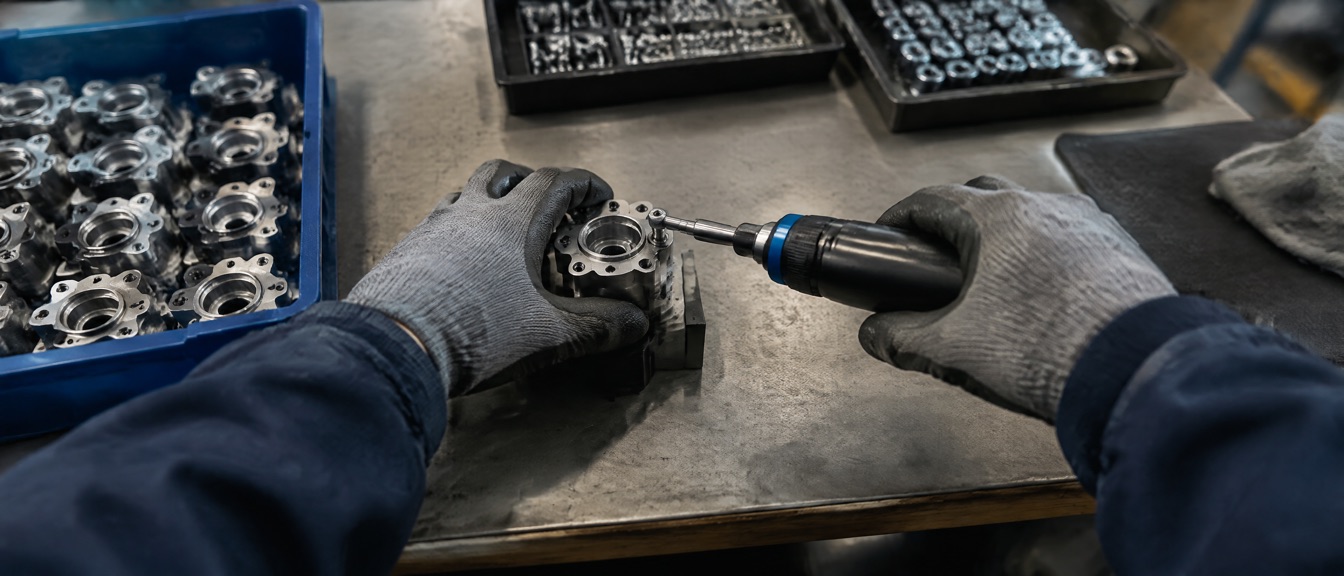
Yes. Amelia Robotics pays manufacturing and fabrication businesses for approved recordings of assembly and machine operation, part trimming and finishing, and metal fabrication and welding. Typical pay is $500 to $2,000 a month per recording employee at 12.5 to 50 approved hours a week, and earnings vary. The business is paid monthly and sets the shares.
- Amelia lists three manufacturing and fabrication examples, including welding.
- Protect customer drawings and proprietary processes: agree what can be filmed before anyone records.
- Data firms are already collecting first-person video from factory workers abroad. US footage from real shops is the gap.
Can my manufacturing company get paid to record production work?
Yes. With Amelia Robotics, operators and fabricators record the work they already do with a head-mounted phone, hands in frame. Amelia pays the business once a month for approved recordings. Typical pay is $500 to $2,000 a month per recording employee, assuming 12.5 to 50 approved hours a week. Amelia says earnings vary and the agreement decides actual pay.
For other industries and how the program works, see how businesses get paid for recording work.
Source: Amelia Robotics: business program (checked Nov 2026)
Which manufacturing tasks count?
Amelia lists three examples for manufacturing and fabrication:
- Assembly and machine operation: hand assembly, fastening, loading and unloading machines.
- Part trimming and finishing: deburring, trimming flash, sanding, polishing.
- Metal fabrication and welding: cutting, fit-up, tack and finish welds, grinding.
Source: Amelia Robotics: business program (checked Nov 2026)
What could your crew earn?
Move the sliders to match your crew.
- Per worker
- $500
- You keep
- $7,500
- Per year
- $180,000
Illustrative, at about $10 per approved hour. Typical pay is $500 to $2,000 a month per recording employee; earnings vary and your agreement decides actual pay.
How much could a manufacturer earn from recordings?
Illustrative maths at the typical rate of $10 per approved hour: people x approved hours a week x 4. Assembly and finishing jobs keep hands busy for most of a shift, so the higher bands are plausible; machine tending with long cycle times will approve fewer hours.
Amelia's split example pays 50% to the worker, 10% to the lead and 40% to the business. You can set a different split for each cell or shift.
| Example crew | People recording | Approved hours a week each | Illustrative monthly payment | Business keeps (40% example) |
|---|---|---|---|---|
| Small fab shop | 5 | 20 | $4,000 | $1,600 |
| Assembly cell, one shift | 15 | 30 | $18,000 | $7,200 |
| Plant with several lines | 40 | 35 | $56,000 | $22,400 |
What should a manufacturer agree before recording?
Start with intellectual property. Customer drawings, part numbers and proprietary fixtures show up in close-up footage. Check NDAs and customer contracts, and agree on the setup call which parts, programs and areas are excluded. Defense or export-controlled work should stay out entirely unless your compliance team approves it.
Then safety. A mount must sit securely with safety glasses, face shields and hearing protection, and must never pull attention near pinch points or rotating equipment. Welding helmets, arc light and spatter make head-mounted phones awkward, so agree a setup for welding on the call. For people: get written agreement from every operator. Some states also set rules for watching staff electronically. Connecticut, for example, requires prior written notice to employees and counts cameras as electronic monitoring (Conn. Gen. Stat. sec. 31-48d).
- No recording of machine screens showing customer programs.
- Keep lockout and guarding procedures exactly as they are.
- Exclude quality records and customer audit areas unless agreed.
Source: Connecticut General Statutes, chapter 557 (sec. 31-48d, electronic monitoring of employees)
Why do robotics companies want factory footage?
Factories are where robots already work, but mostly on fixed, repetitive jobs. The next step is varied hand work. CNN reports that the data company Labellerr AI began collecting first-person videos from workers at manufacturing facilities in India, and that Micro1's head of robotics data put manufacturing first on his list of places this data is needed (CNN).
Instawork built its wearable camera system for real commercial settings including light manufacturing (Instawork). US shops with skilled fabricators and a wide mix of parts offer variety that buyers find hard to source. See manufacturing robots for what is already on the floor.
Source: CNN via Scripps News: How filming your chores could train the android butlers of the future
How does a manufacturer get started?
Apply in four questions, agree tasks and requirements on a setup call, get activated, then invite your operators. Prepare:
- Headcount by line or cell, with hands-on hours per week.
- A list of excluded parts, customers and areas.
- Phones and head mounts that work with your PPE. Amelia's setup guidance says the business buys one mount per person.
- A split plan per shift or cell.
Next step
Compare with carpentry and furniture workshops, or estimate your floor on the physical AI hub.
Common questions
Can a factory get paid to record workers for robot training?
Yes. Amelia lists assembly and machine operation, finishing, and fabrication and welding. Typical pay is $500 to $2,000 a month per recording employee; earnings vary.
Is it legal to record my production workers?
Usually with notice and agreement, but state rules differ. Connecticut, for example, requires prior written notice of electronic monitoring and counts cameras. Check with a lawyer.
Will recording expose our customers' designs?
Only if you let it. Agree excluded parts, drawings and screens on the setup call, and check NDAs first.
Do my workers have to agree?
Yes. Get written agreement; workers start each recording themselves.
How much can a 15-person assembly cell earn?
At the typical rate of $10 per approved hour, 15 people at 25 approved hours a week is $15,000 a month. Illustrative only.
Will robots trained on this replace my operators?
The footage teaches robots hand tasks, so be honest about that. The International Federation of Robotics research chair told CNN humanoid success rates on tasks like folding T-shirts are around 70 to 80%, too low for commercial use.
Sources and further reading
- Amelia Robotics: business program (checked Nov 2026)
- Amelia Robotics: for robotics labs
- Connecticut General Statutes, chapter 557 (sec. 31-48d, electronic monitoring of employees)
- CNN via Scripps News: How filming your chores could train the android butlers of the future
- Instawork: Instawork Robotics Lab debuts Instacore (press release)
Origin Data Partners is independent. We may be paid by our partner when a business we introduce is paid; it never comes out of your earnings. How Origin is paid.