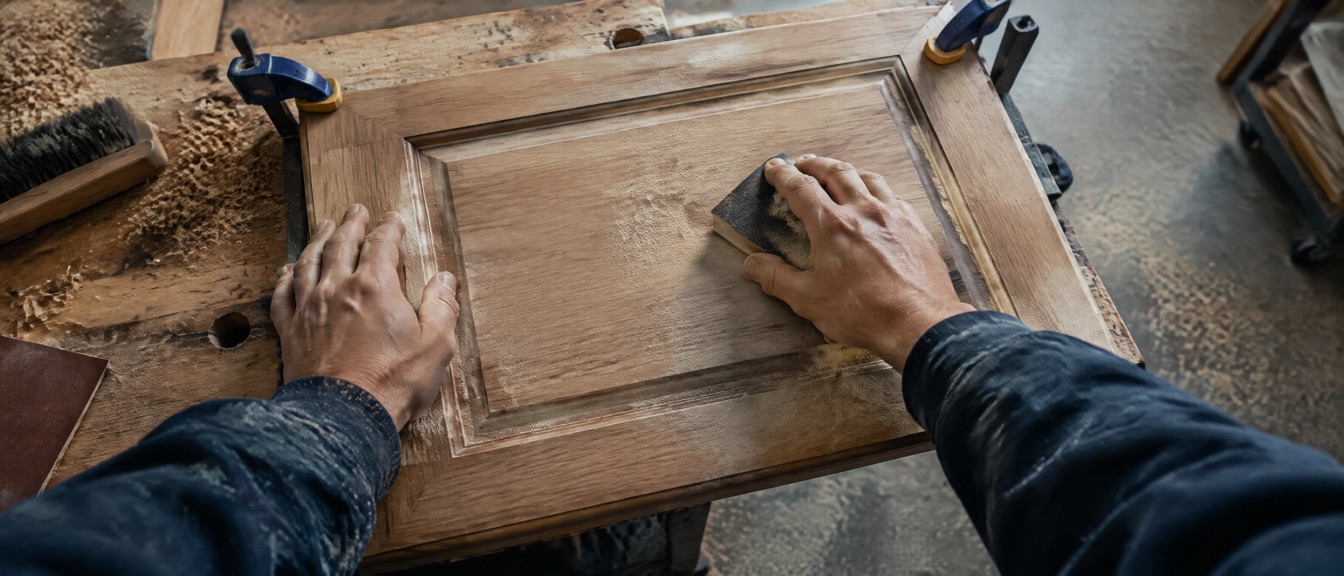
Yes. Amelia Robotics pays carpentry and furniture workshops for approved recordings of furniture assembly and woodworking, and sanding, surface preparation and painting. Typical pay is $500 to $2,000 a month per recording employee at 12.5 to 50 approved hours a week, and earnings vary. The shop is paid monthly and decides the shares.
- Amelia lists two workshop examples: assembly and woodworking, and sanding, prep and painting.
- Small shops can take part: even a two-person shop adds a modest line, illustratively.
- Blades, dust and finishes: a mount must never distract near a saw or block a respirator.
Can my woodshop get paid to record our work?
Yes. Amelia Robotics pays workshops for approved recordings of the work their makers already do. A phone on a head mount films the bench from the worker's view with hands in frame, and Amelia pays the business once a month. Typical pay is $500 to $2,000 a month per recording employee, assuming 12.5 to 50 approved hours a week over four weeks. Earnings vary.
Shops building custom pieces have an edge: every job is a bit different, and variety is what robot training needs. Start at the physical AI hub for the full picture.
Source: Amelia Robotics: business program (checked Nov 2026)
Which woodworking and furniture tasks count?
Amelia lists two examples for carpentry and furniture workshops:
- Furniture assembly and woodworking: joinery, glue-ups, clamping, hardware, flat-pack and custom assembly.
- Sanding, surface preparation and painting: hand and orbital sanding, filling, priming, spraying and brushing finishes.
Source: Amelia Robotics: business program (checked Nov 2026)
What could your crew earn?
Move the sliders to match your crew.
- Per worker
- $400
- You keep
- $1,600
- Per year
- $38,400
Illustrative, at about $10 per approved hour. Typical pay is $500 to $2,000 a month per recording employee; earnings vary and your agreement decides actual pay.
How much could a small workshop earn?
At the typical rate of $10 per approved hour, the illustrative maths is people x approved hours a week x 4. Time at the bench and finishing booth counts; design work and customer meetings do not.
Amelia's example split is 50% worker, 10% lead and 40% business. In a two-person shop where the owner works the bench, the owner's own recorded hours count too, if Amelia approves them under your agreement.
| Example crew | People recording | Approved hours a week each | Illustrative monthly payment | Business keeps (40% example) |
|---|---|---|---|---|
| Owner plus one | 2 | 15 | $1,200 | $480 |
| Small cabinet shop | 5 | 25 | $5,000 | $2,000 |
| Furniture maker with finishing room | 10 | 30 | $12,000 | $4,800 |
What should a workshop agree before recording?
Safety comes first. Table saws, routers and jointers need full attention, and a phone that shifts or slips is a distraction near a blade. Agree which machines are in scope; many shops will keep power-tool cuts out and record assembly, sanding and finishing instead. In the spray booth, the mount must not break the seal of a respirator, and phones need protection from overspray and dust.
On consent: get written agreement from everyone who records. Some states also set rules for watching staff electronically. Connecticut, for example, requires prior written notice to employees and counts cameras as electronic monitoring (Conn. Gen. Stat. sec. 31-48d). If you build commissioned pieces, check whether a client wants their design kept private.
- Keep client drawings and names out of frame.
- Protect phones from fine dust and finishing chemicals.
- Never remove guards or change technique for the camera.
Source: Connecticut General Statutes, chapter 557 (sec. 31-48d, electronic monitoring of employees)
Why do robotics companies want woodworking footage?
Sanding, fitting joints and applying finish are about feel: pressure, angle and when to stop. Robots learn that from watching hands. A writer who recorded for this market told NPR the head camera focuses on both hands because that is how robots interact with the world (NPR).
Variety is the other draw. Micro1's head of robotics data told CNN robots need data from basically every environment because the movements differ (CNN). See how robots learn from video for the technical side.
Source: NPR via KUNC: He filmed himself doing household tasks for AI robots (May 2026)
How does a workshop get started?
Apply with four questions, agree tasks and requirements on a setup call, get activated, then invite your team. Prepare:
- Headcount and bench hours per person per week.
- Which machines and tasks are in scope.
- Phones and head mounts. Amelia's setup guidance says the business buys one mount per person.
- A split plan, even for a two-person shop.
Next step
See how larger shops approach this on the manufacturing and fabrication page, or estimate your shop on the physical AI hub.
Common questions
Can a furniture workshop get paid to record woodworking?
Yes. Amelia lists furniture assembly and woodworking, plus sanding, prep and painting. Typical pay is $500 to $2,000 a month per recording employee; earnings vary.
Can a two-person shop take part?
Amelia's materials do not set a minimum crew size on the page. Illustratively, 2 people at 15 approved hours a week is $1,200 a month at the typical rate.
Is it safe to wear a phone near a table saw?
Only if it is secure and never distracts. Many shops will keep power-tool cuts out of scope and record assembly and finishing instead.
Do my workers have to agree?
Yes. Get written agreement and let workers start recordings themselves.
Is it legal to record employees in a workshop?
Usually with notice and agreement, but state rules differ; Connecticut requires prior written notice of electronic monitoring. Check with a lawyer.
Will robots replace furniture makers?
The footage helps robots learn hand skills, so be honest about that. Custom, varied work is among the hardest things for robots to do.
Sources and further reading
- Amelia Robotics: business program (checked Nov 2026)
- Amelia Robotics: for robotics labs
- Connecticut General Statutes, chapter 557 (sec. 31-48d, electronic monitoring of employees)
- NPR via KUNC: He filmed himself doing household tasks for AI robots (May 2026)
- CNN via Scripps News: How filming your chores could train the android butlers of the future
Origin Data Partners is independent. We may be paid by our partner when a business we introduce is paid; it never comes out of your earnings. How Origin is paid.