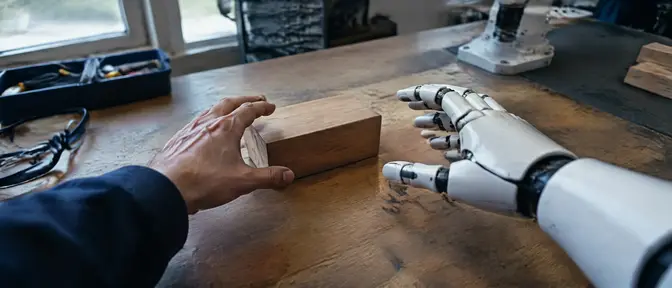
Possibly, with more conditions than most workplaces. Research groups are training robot models on video of bench work such as pipetting, and at least one data vendor sells first-person lab video. But no business recording program we read on 15 November 2026 names laboratories in its list of accepted work, and none publishes a lab rate. A lab also has to clear patient privacy, sponsor confidentiality, study rules and biosafety before a camera goes on. Tell Origin what your lab does and we'll tell you whether a program will take it.
- The work that suits recording is routine and manual: pipetting, plate and tube handling, sample preparation, loading instruments, set-up and cleaning.
- Never in frame: patient identifiers, screens, notebooks, sponsor labels and codes, and anything from a regulated study without the study director's agreement.
- Four parties have to agree: the lab director, the institution, any sponsor or client whose work is on the bench, and each person who records.
Would AI or robotics companies pay for video of our bench work?
The interest is real. A 2026 paper on LabWorld evaluates a model on real pipetting and vortexing videos collected in the authors' laboratory, and LabVLA is a vision-language-action model built for scientific laboratories. A data vendor's public catalogue, read on 15 November 2026, lists a first-person lab video dataset covering pipetting, centrifuging, microscopy and sample handling in wet labs, dry labs and cleanrooms, made for training robotic lab assistants.
The route for a working lab is less settled. The business recording programs whose public pages we read on 15 November 2026 list trades, kitchens, warehouses, workshops and similar sites. None lists laboratories and none publishes a lab rate. One invites businesses with other work to say so when they apply, and confirms tasks on a call, so a published list is not always the last word. So treat this page as how to get a lab ready and what to ask, not as a promise that a program is waiting. Origin can ask on your behalf once we know what your lab does.
Which lab work is worth recording?
Robots struggle with exactly the tasks a technician stops noticing: opening a tube one-handed, seating a tip, judging a meniscus, loading a rotor so it balances. Footage is useful when the hands and the labware are in frame and the task runs from start to finish.
Poor candidates are the long stretches with nothing for the hands to do. Incubations, instrument runs and time at a keyboard do not count as recorded task time, so expect approved hours in a lab to be a modest share of the day. Good candidates:
- Manual pipetting, serial dilutions and plate filling
- Tube and plate handling: labelling, racking, capping, sealing, moving between stations
- Sample preparation: weighing, dissolving, filtering, aliquoting
- Loading and unloading centrifuges, autosamplers, incubators and plate readers
- Making up buffers and media
- Glassware washing, bench set-up, restocking and cleaning down
What could your crew earn?
Move the sliders to match your crew.
- Per worker
- $250
- You keep
- $1,500
- Per year
- $36,000
Illustrative, at about $10 per approved hour, the rate implied by one program’s example. Per worker and per year are estimates on the same basis. One program’s published estimate is $500 to $2,000 a month per recording employee; earnings vary and your agreement decides actual pay.
What is never recorded in a lab?
Start from the rule that a camera sees everything in front of it, including what nobody meant to show. In a clinical lab that means patient information. The CLIA regulations say a laboratory "must ensure confidentiality of patient information throughout all phases of the total testing process that are under the laboratory's control" (42 CFR 493.1231). The HIPAA de-identification standard lists what counts as identifying, and the list includes names, medical record numbers, device identifiers and serial numbers, and full face photographic images (45 CFR 164.514). A requisition, a tube label or a results screen in the background of a clip is a disclosure.
Set these as fixed rules, written down, before the first session:
- No patient or donor samples with readable labels, no requisitions, no accessioning stations.
- No screens: LIMS, instrument software, results, email. Angle the camera at the bench or cover the monitor.
- No notebooks, batch records, protocols, whiteboards or printed SOPs in frame.
- No sponsor or client material that can be identified: compound codes, study numbers, branded kits under evaluation.
- No animal work and no animal facilities.
- No faces of people who have not agreed, and no sound.
Who has to agree before a lab records?
In a university, start with who signs for the lab. A principal investigator usually cannot bind the institution to a commercial agreement, and payment will go to the institution, not to the group. Ask the research office early; that conversation takes longer than everything else.
More people have a say than in a workshop, because a lab rarely owns everything on its benches:
- The lab director or principal investigator, who decides which benches and tasks are in scope.
- The institution or company: legal or the research office for the agreement, and environmental health and safety or the biosafety officer for bringing a device into the lab.
- Any sponsor or client whose samples, methods or materials would be on camera. Contract research and testing agreements normally carry confidentiality terms; read yours, and get written permission where the work is theirs.
- Each person who records, in writing and by choice. Students and trainees should never feel it is expected of them.
What changes in a CLIA, GLP or biosafety lab?
Clinical labs: the confidentiality standard above applies to everything under the lab's control. The practical answer is to record only work with no patient material in view, such as reagent preparation, maintenance and set-up, or to use contrived samples.
GLP labs: FDA's good laboratory practice rule defines raw data as "any laboratory worksheets, records, memoranda, notes, or exact copies thereof, that are the result of original observations and activities of a nonclinical laboratory study and are necessary for the reconstruction and evaluation of the report of that study" (21 CFR 58.3). A video of study work is not obviously inside that definition, and not obviously outside it. Do not create the question. Keep cameras off regulated study work unless the study director, quality assurance and the sponsor have agreed in writing how the recording is treated.
Biosafety and chemical hygiene: a phone or camera taken into the lab is equipment. OSHA's bloodborne pathogens standard requires equipment that may be contaminated to be examined and decontaminated as necessary before it is serviced or shipped (29 CFR 1910.1030), and the laboratory standard requires a written Chemical Hygiene Plan wherever hazardous chemicals are used (29 CFR 1910.1450). Decide where the device lives, how it is wiped down and whether it leaves the lab at all. A head mount must not get in the way of eye protection, a face shield or a hood sash. This is a summary of what the rules say, not legal advice. Check your own contracts and ask a lawyer where the stakes are high.
What could a lab earn?
No program publishes a lab rate, so there is no lab figure to quote. For other kinds of work: Three business recording programs publish figures on their own pages, read on 15 November 2026. One pays $12 to $18 per approved hour, depending on the kind of work. One pays a flat $35 for every recorded hour in a booked session. One gives its own estimate of $500 to $2,000 a month per recording employee, assuming 12.5 to 50 approved hours a week. These are the programs' statements, not a promise of pay: the agreement you sign and the hours a program accepts decide what arrives.
The table is arithmetic, not an offer. It uses about $10 per approved hour, which is what the $500 to $2,000 estimate works out to, and modest hours because much of a lab day is not hands-on. A lab's real figure would be set by the program that takes it.
| Example crew | People recording | Approved hours a week each | Illustrative monthly payment to the business |
|---|---|---|---|
| Small testing lab | 4 | 10 | $1,600 |
| Core facility or prep room | 6 | 12.5 | $3,000 |
| Contract lab, two shifts | 12 | 12.5 | $6,000 |
How does recording fit a normal shift?
Pick two or three routine tasks at one bench and start there. The person recording puts on the head mount outside the work area, checks the frame shows hands and labware, and starts a recording at the beginning of a task and stops it at the end. Between tasks the camera is off. At the end of the shift the device is wiped down and stored where your safety officer has agreed.
Review the first week's clips yourselves before anything is uploaded. You are looking for labels, screens and reflections. Fix the camera angle or the bench layout, then widen the scope.
Your experiment records may be worth more than the video
Footage shows how a task is done. Records show what happened: runs, conditions, results, and the failed attempts that never reached a paper. AI companies license those from labs, and they ask for failures by name. If your lab owns several years of them, read licensing R&D experiment records and biotech, CRO and lab data, then see what your company records are worth.
Next step
To find out whether a program will take your lab's work, check whether your business qualifies and choose "Laboratory". Tell us what kind of lab you run.
Common questions
Do robotics companies want lab footage?
There is research and commercial interest: 2026 papers train and test models on pipetting videos, and at least one data vendor lists a first-person lab video dataset. But no business recording program we read on 15 November 2026 names labs in its accepted work, and none publishes a lab rate.
Can a university lab get paid to record bench work?
Possibly, through the institution. A principal investigator usually cannot sign a commercial agreement alone, and payment would go to the university. Ask your research office first, and make sure students take part only by choice.
What about sponsor confidentiality when a contract lab records?
Sponsor and client agreements normally restrict disclosure of their materials and methods. Record only your own routine work with nothing of theirs in frame, or get the sponsor's written permission. Check your own agreement.
Do lab staff have to consent to being recorded?
Yes. Each person who wears the camera should opt in, in writing, and be free to stop. Colleagues who have not agreed stay out of frame. Recording without sound avoids state laws on recording conversations.
Can a lab license its experiment records as well as footage?
Yes, and for many labs the records are the larger asset. Run records, results and failed experiments are licensed to AI companies separately from any video. See licensing R&D experiment records.
Sources and further reading
- 42 CFR 493.1231: CLIA, confidentiality of patient information (eCFR)
- 45 CFR 164.514: HIPAA de-identification standard (eCFR)
- 21 CFR 58.3: good laboratory practice definitions (eCFR)
- 29 CFR 1910.1030: OSHA bloodborne pathogens (eCFR)
- 29 CFR 1910.1450: OSHA laboratory standard (eCFR)
- LabWorld: Learning Interactive 4D Worlds for Scientific Experimentation (arXiv, Oct 2026)
- LabVLA: Grounding Vision-Language-Action Models in Scientific Laboratories (arXiv, Jun 2026)
Origin Data Partners is independent and does not represent Amelia Robotics. Origin may earn a reward from Amelia Robotics if a business it introduced joins and gets paid; Amelia pays that reward itself. Origin charges your business nothing. How Origin is paid.