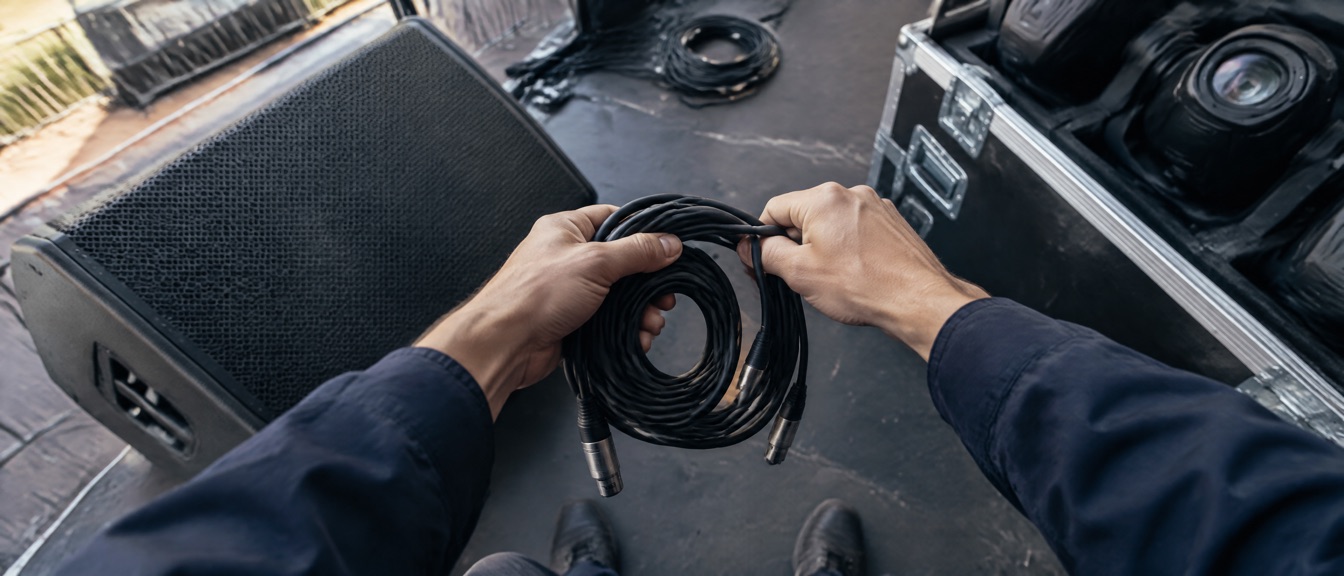
Yes. Amelia Robotics pays event venues for approved recordings of crew work such as stage setup and teardown, AV and cable management and event restroom sanitation. Typical pay is $500 to $2,000 a month per recording employee at 12.5 to 50 approved hours a week, and earnings vary. Payment goes to the venue monthly; you set the shares.
- Amelia lists three event examples and uses an event services company in its own illustrative statement.
- Record load-in and load-out, not the event itself. Guests and performers should stay out of frame.
- Restroom sanitation is only recorded when the room is closed and empty.
Can my event venue get paid to record our crew?
Yes. Amelia Robotics pays venues for approved recordings of the physical work crews already do. A phone on a head mount records setup, cabling or cleaning from the worker's view, hands in frame. Amelia pays the venue once a month with a statement. Typical pay is $500 to $2,000 a month per recording employee, assuming 12.5 to 50 approved hours a week. Amelia says earnings vary.
Amelia's own sample statement uses a fictional event services company with a load-in crew and a front-of-house team, which shows how teams and splits work in practice. See the physical AI hub for the full program.
Source: Amelia Robotics: business program (checked Nov 2026)
Which event venue tasks count?
Amelia lists three examples for event venues:
- Stage setup and teardown: decking, risers, drape, staging and furniture.
- AV and cable management: running, taping and coiling cable, rigging speakers and screens.
- Event restroom sanitation: restocking, cleaning and resetting between events.
Source: Amelia Robotics: business program (checked Nov 2026)
What could your crew earn?
Move the sliders to match your crew.
- Per worker
- $300
- You keep
- $2,400
- Per year
- $57,600
Illustrative, at about $10 per approved hour. Typical pay is $500 to $2,000 a month per recording employee; earnings vary and your agreement decides actual pay.
How much could a venue crew earn from recordings?
Event work is bursty. A wedding weekend can be intense; a quiet week may have little. The table shows illustrative maths at the typical rate of $10 per approved hour (people x approved hours a week x 4), using modest hours to reflect gaps between events.
Amelia's split example is 50% worker, 10% lead and 40% business, and you can set different splits for each team, such as load-in crews and housekeeping.
| Example crew | People recording | Approved hours a week each | Illustrative monthly payment | Business keeps (40% example) |
|---|---|---|---|---|
| Small venue team | 4 | 12.5 | $2,000 | $800 |
| Mid-size venue | 10 | 20 | $8,000 | $3,200 |
| Large venue or event services company | 25 | 25 | $25,000 | $10,000 |
What should a venue agree before recording?
Guests, clients and performers did not sign up for this, so the simplest rule is to record before doors open and after the event ends. Check your client contracts and any performer or production agreements for limits on cameras. If you work with union stagehands, check whether your agreement covers recording.
For your own crew, get written agreement from everyone who records. Some states also set rules for watching staff electronically. Connecticut, for example, requires prior written notice to employees and counts cameras as electronic monitoring (Conn. Gen. Stat. sec. 31-48d). Venues are full of conversation. About 11 states, including California, Florida, Illinois, Pennsylvania and Washington, require everyone in a conversation to agree before it is recorded (Reporters Committee for Freedom of the Press). Keep sound off or agree how audio is handled on the setup call.
- Restrooms: record only when closed, empty and signed as closed for cleaning.
- Never record during rigging over people, or when a mount could fall from height.
- Keep client names, run sheets and stage plots out of frame.
Source: Reporters Committee for Freedom of the Press: Reporter's Recording Guide
Why would robotics companies want event footage?
Setup and teardown combine heavy lifting with fiddly work: locking deck legs, coiling cable properly, routing it safely. Robot developers want this kind of varied, hands-on data from real workplaces. Instawork describes building its camera rig to capture data in the commercial environments where robots will actually be deployed (Instawork).
Cleaning tasks are a big part of the demand too. DoorDash pays couriers to film everyday tasks like dishwashing for robotics training, according to TechCrunch (TechCrunch). See also commercial cleaning if your venue runs its own janitorial team.
Source: Instawork: Instawork Robotics Lab debuts Instacore (press release)
How does a venue get started?
Apply in four questions, agree tasks and requirements on a setup call, get activated and invite your crew. Prepare:
- Crew size by team and typical setup, teardown and cleaning hours per week.
- Your event calendar, so expected hours are realistic.
- Phones and head mounts. Amelia's setup guidance says the business buys one mount per person.
- A list of areas and events that are excluded.
Next step
See how hotels with event spaces handle this, or estimate your crew on the physical AI hub.
Common questions
Can an event venue get paid to record stage setup and teardown?
Yes. Amelia lists stage setup and teardown as an example. Typical pay is $500 to $2,000 a month per recording employee; earnings vary.
Will guests be on camera?
They should not be. Record before doors and after close, and keep the camera on the crew's hands and equipment.
Is it legal to record my event staff?
With their agreement and proper notice, in most cases. About 11 states require all parties' consent to record conversations, so be careful with audio. Check with a lawyer.
Do my workers have to agree?
Yes. Get written agreement, and let workers start each recording themselves.
How much can a 10-person venue crew earn?
At the typical rate of $10 per approved hour, 10 people at 20 approved hours a week is $8,000 a month. Illustrative only.
Do robots trained on this replace event crews?
The data helps robots learn tasks like these, so be open about that. Today, varied hands-on work like rigging and cable runs is still hard for robots.
Sources and further reading
- Amelia Robotics: business program (checked Nov 2026)
- Amelia Robotics: for robotics labs
- Reporters Committee for Freedom of the Press: Reporter's Recording Guide
- Connecticut General Statutes, chapter 557 (sec. 31-48d, electronic monitoring of employees)
- Instawork: Instawork Robotics Lab debuts Instacore (press release)
- TechCrunch: DoorDash launches a Tasks app that pays couriers to submit videos to train AI (March 2026)
Origin Data Partners is independent. We may be paid by our partner when a business we introduce is paid; it never comes out of your earnings. How Origin is paid.