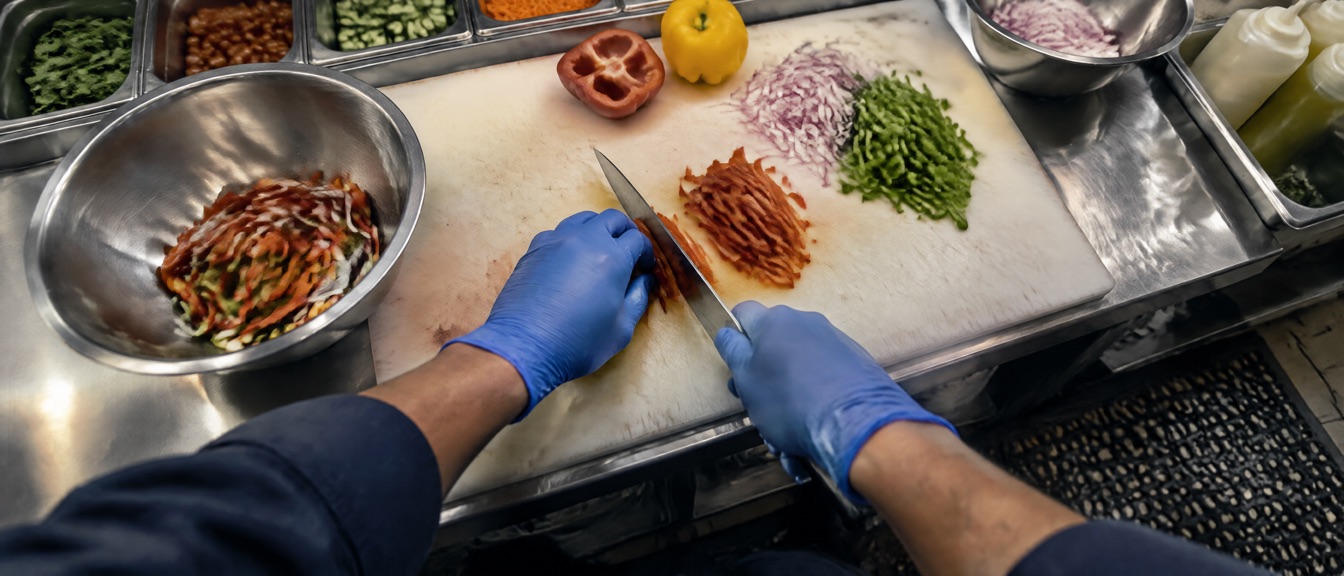
Yes. Amelia Robotics pays restaurants and commercial kitchens for approved recordings of food prep and line cooking, baking and cake decorating, and dishwashing and deep cleaning. Typical pay is $500 to $2,000 a month per recording employee at 12.5 to 50 approved hours a week, and earnings vary. The restaurant is paid monthly and sets the crew shares.
- Amelia lists three kitchen examples, from line cooking to dishwashing.
- Health code first: the phone must be secured, hands washed after touching it, and hair restraints still worn.
- Record back of house only. Guests stay out of frame.
Can my restaurant get paid to record kitchen work?
Yes. Through Amelia Robotics, cooks, bakers and dishwashers record the work they already do with a head-mounted phone, hands in frame. Amelia reviews the recordings and pays the restaurant once a month for approved hours. Typical pay is $500 to $2,000 a month per recording employee, assuming 12.5 to 50 approved hours a week. Earnings vary, and your agreement decides actual pay.
For thin-margin businesses, a new monthly line with no new customers can matter; see typical restaurant profit margins. The physical AI hub covers the program in full.
Source: Amelia Robotics: business program (checked Nov 2026)
Which kitchen tasks count?
Amelia lists three examples for restaurants and commercial kitchens:
- Food preparation and line cooking: knife work, portioning, sauté, grill and plating.
- Baking and cake decorating: mixing, shaping, piping and finishing.
- Dishwashing and kitchen deep cleaning: dish pit, pots, hoods, floors and equipment.
Source: Amelia Robotics: business program (checked Nov 2026)
What could your crew earn?
Move the sliders to match your crew.
- Per worker
- $300
- You keep
- $2,400
- Per year
- $57,600
Illustrative, at about $10 per approved hour. Typical pay is $500 to $2,000 a month per recording employee; earnings vary and your agreement decides actual pay.
How much could a kitchen crew earn from recordings?
At the typical rate of $10 per approved hour, the illustrative maths is people x approved hours a week x 4. Many kitchen staff work part-time shifts, so the table uses modest hours. Prep shifts and closing deep cleans are often easier to record than a slammed dinner service.
Amelia's split example is 50% worker, 10% lead, 40% business, and you can set a different split for each team. A clear written split avoids friction between front and back of house, since only kitchen staff will be recording.
| Example crew | People recording | Approved hours a week each | Illustrative monthly payment | Business keeps (40% example) |
|---|---|---|---|---|
| Small cafe or bakery | 4 | 15 | $2,400 | $960 |
| Full-service restaurant kitchen | 10 | 20 | $8,000 | $3,200 |
| Commissary or high-volume kitchen | 20 | 25 | $20,000 | $8,000 |
Does recording break food safety or health code rules?
Your kitchen answers to your local health code, and state and local regulators use the FDA Food Code as the model for those rules (FDA). Nothing there bans a camera, but the same hygiene logic applies to a phone as to anything else near food: it must not fall into food, it is a touch surface that can contaminate hands, and it must not get in the way of hair restraints.
Agree how this works before anyone records. Some states also set rules for watching staff electronically. Connecticut, for example, requires prior written notice to employees and counts cameras as electronic monitoring (Conn. Gen. Stat. sec. 31-48d). Kitchens are loud, but if audio is captured, about 11 states, including California, Florida, Illinois, Pennsylvania and Washington, require everyone in a conversation to agree before it is recorded (Reporters Committee for Freedom of the Press).
- Secure the phone so it cannot drop into food, fryers or mixers. Wear the mount over or with the hat or hair net, never instead of it.
- Start and stop recordings before washing hands or putting on gloves, and wash again after touching the phone.
- Wipe phones and mounts with food-safe sanitizer at the start of each shift.
- Record back of house only. Keep guests, the dining room and tickets with names out of frame.
Source: FDA: FDA Food Code
Why do AI companies want restaurant kitchen footage?
Kitchens are one of the main targets for robot developers. Instawork built its wearable camera system for real commercial kitchens, warehouses, hotels and light manufacturing (Instawork). DoorDash pays couriers to film tasks such as washing dishes with a body camera, according to TechCrunch (TechCrunch).
Professional cooks add something home videos lack: speed, consistent technique and commercial equipment. For the robots already working in kitchens, see restaurant robots.
Source: Instawork: Instawork Robotics Lab debuts Instacore (press release)
How does a restaurant get started?
Apply with four questions, agree tasks and requirements on the setup call, get activated, then invite your kitchen team. Prepare:
- Kitchen headcount and hands-on hours by role (prep, line, pastry, dish).
- Which shifts and stations you will record.
- Phones and head mounts that work with hats and nets. Amelia's setup guidance says the business buys one mount per person.
- A written hygiene routine for phones and a split plan.
Next step
See what restaurant owners make for context, or estimate your kitchen on the physical AI hub calculator.
Common questions
Do AI companies pay restaurants for kitchen video?
Amelia Robotics does. It lists food prep and line cooking, baking and dishwashing, typically paying $500 to $2,000 a month per recording employee; earnings vary.
Is a camera in the kitchen allowed under the health code?
Your local code, usually based on the FDA Food Code, covers hygiene rather than cameras. Secure the phone, keep hair restraints on and wash hands after touching it. Ask your inspector if unsure.
Will customers be on camera?
They should not be. Record back of house only and keep the dining room and named tickets out of frame.
Do my cooks have to agree?
Yes. Get written agreement from each person; workers start each recording themselves.
How much can a 10-person kitchen earn recording work?
At the typical rate of $10 per approved hour, 10 people at 20 approved hours a week is $8,000 a month. Illustrative only.
Will kitchen robots trained on this replace my cooks?
The footage helps robots learn kitchen tasks, so be honest with your team. Researchers quoted by CNN say robots still lack the feel for forces and friction that cooks build over years.
Sources and further reading
- Amelia Robotics: business program (checked Nov 2026)
- Amelia Robotics: for robotics labs
- FDA: FDA Food Code
- Connecticut General Statutes, chapter 557 (sec. 31-48d, electronic monitoring of employees)
- Reporters Committee for Freedom of the Press: Reporter's Recording Guide
- Instawork: Instawork Robotics Lab debuts Instacore (press release)
- TechCrunch: DoorDash launches a Tasks app that pays couriers to submit videos to train AI (March 2026)
- CNN via Scripps News: How filming your chores could train the android butlers of the future
Origin Data Partners is independent. We may be paid by our partner when a business we introduce is paid; it never comes out of your earnings. How Origin is paid.