Yes, robots are used in US restaurants, but at single stations. White Castle planned Miso Robotics' Flippy 2 fry robot for 100 locations, Sweetgreen's Infinite Kitchen makeline delivers at least 7 points of labor savings in its stores, Chipotle is piloting an avocado robot and an automated bowl line, and serving robots such as Bear Robotics' Servi rent for a monthly fee. Prep, cooking to order and service are still done by people.
- Kitchen robots take one station: the fryer, the bowl line, avocado prep or carrying plates. No robot runs a full kitchen shift.
- Most are leased or bundled with a service fee. Bear Robotics charged $999 a month for Servi in the US in 2022.
- Operators mostly expect technology to support staff: 69% said it will augment rather than replace labor in the NRA's 2024 report.
Are robots used in restaurants in the US?
Yes, mainly in fast food and fast casual chains with high volume and a fixed menu. White Castle announced plans in 2022 to install Miso Robotics' Flippy 2 in 100 locations; the robot takes over the work of an entire fry station. Sweetgreen's Infinite Kitchen is an automated makeline that assembles bowls; the company planned at least 25 new Infinite Kitchens in 2025.
Chipotle moved two cobotic systems into real restaurants in 2024: Autocado, which cuts, cores and peels avocados, and an Augmented Makeline for digital bowl orders. Both are pilots, not chainwide rollouts. In dining rooms, serving robots carry plates and bus trays while staff take orders and look after guests.
| Company | Robot and task | Status | Source |
|---|---|---|---|
| Miso Robotics with White Castle | Flippy 2 runs the fry station | Deployed; 100 locations planned | Miso Robotics |
| Sweetgreen | Infinite Kitchen automated bowl makeline | Deployed in a growing share of stores | QSR Magazine |
| Chipotle with Vebu and Hyphen | Autocado avocado prep and Augmented Makeline | Pilot in restaurants | Nation's Restaurant News |
| Bear Robotics | Servi serving and bussing robot | Deployed, leased monthly | Euronews |
How much does a restaurant robot cost?
Restaurant robots are usually leased or charged as a monthly service. Reuters, reported by Euronews, said in 2022 that Bear Robotics charged $999 a month for Servi in the US. Kitchen systems like Flippy and Sweetgreen's makeline are built into chain store designs, and their full costs are not public.
For an independent restaurant, the comparison is simple: the monthly fee against the hours it saves on your slowest, most repetitive task, minus the time staff spend loading, cleaning and fixing the machine. Robots pay off soonest where the menu is narrow and the volume is high.
How many restaurants use robots?
Adoption is concentrated in chains. Sweetgreen said its Infinite Kitchen stores were delivering at least 7 percentage points in labor savings compared with similar stores. In the National Restaurant Association's 2024 report, 47% of operators expected technology and automation to become more common to deal with labor shortages.
The industry is still adding people. The NRA expects total restaurant employment to reach 15.8 million in 2026, and the BLS projects about 135,700 openings a year for food preparation workers even as that job count declines 3 percent from 2025 to 2035.
What can restaurant robots still not do?
Most of a kitchen. Prepping varied ingredients, cooking to order on a busy line, plating, tasting, dealing with a ticket that changes halfway through, cleaning a cluttered station and handling a walk-in delivery all need hands that adapt every few seconds. Robots also struggle with the variety of an independent restaurant's menu.
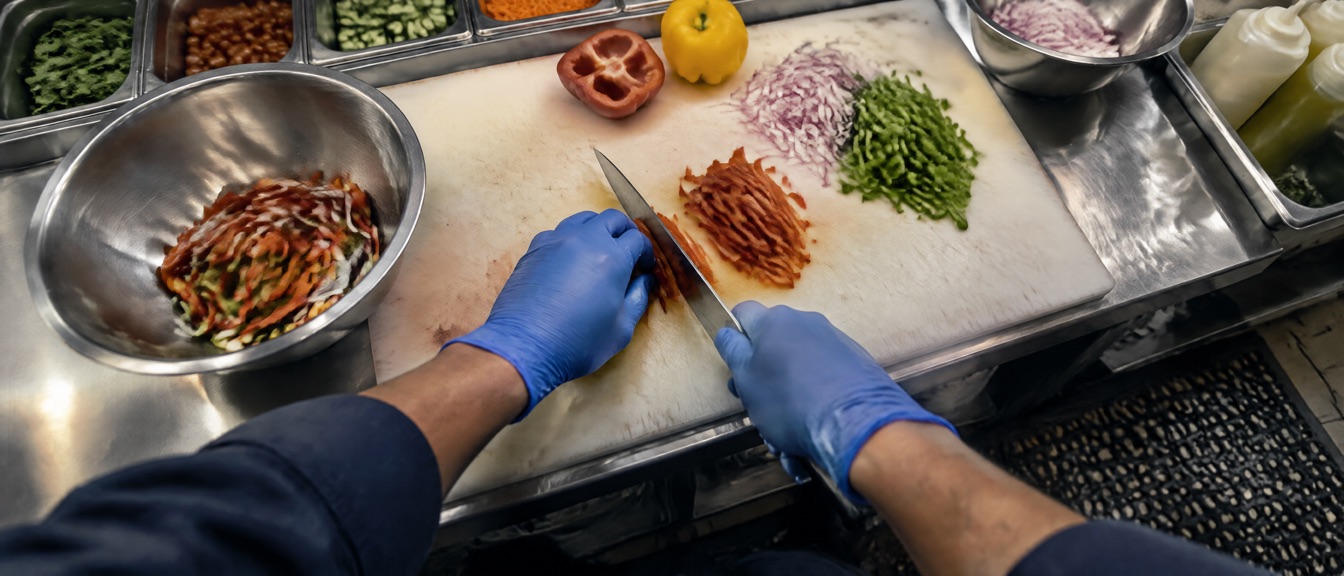
That is the gap robot labs are trying to close, and it is why they want first-person footage of real cooks and prep staff working real shifts, not staged demos.
Will robots replace restaurant workers?
Operators mostly do not expect that. In the NRA's 2024 report, 69% of operators said technology will augment rather than replace human labor. The likely change is that robots take the hot, repetitive stations, like the fryer, while people handle cooking, hospitality and everything that varies.
For owners, keeping a reliable kitchen crew matters more than any robot. Extra pay that does not raise your fixed costs helps. See what restaurant owners earn and typical restaurant margins for context.
Why robot makers need footage of your crew
Kitchen robots learn from examples of people doing the work. Figure has shown a humanoid learning from 100% egocentric human video with no robot demonstrations, and labs want the same view of prep, line cooking and dishwashing. Read how robots learn from video for why.
Amelia Robotics pays businesses for approved recordings of work their crews already do. A phone is mounted so it films the task from the worker's view with the hands in frame, and each worker starts a recording deliberately. Tasks, permitted areas and participants are agreed on a setup call before anyone records, and you can leave out jobs or areas. Payment goes to the business once a month with a statement, and you decide how much to share with the crew.
Illustrative example: a restaurant with 5 kitchen staff who each record 15 approved hours a week would earn about $3,000 a month at the typical rate (5 x 15 x 4 x $10). Amelia's typical pay is $500 to $2,000 a month per recording employee, assuming 12.5 to 50 approved hours a week. Earnings vary, and your agreement and approved recordings decide actual pay. See what counts on our restaurants and commercial kitchens page.
Next step
See how restaurants and kitchens get paid for recording work and estimate your own crew in the calculator.
Common questions
Are robots used in restaurants in the US?
Yes, at single stations in chains: White Castle uses Miso's Flippy 2 fry robot, Sweetgreen runs an automated makeline, Chipotle is piloting avocado and bowl robots, and many restaurants lease serving robots.
How much does a restaurant robot cost?
Most are leased. Bear Robotics charged $999 a month for its Servi serving robot in the US in 2022; costs of kitchen systems in chains are not public.
Will robots replace restaurant workers?
Not broadly. 69% of operators in the NRA's 2024 report said technology will augment rather than replace staff, and BLS projects 135,700 food prep openings a year.
What restaurant tasks can robots do?
Frying, dispensing and assembling bowls, peeling avocados and carrying plates. Cooking to order, prep variety and service are still done by people.
Does Chipotle use robots?
Chipotle is piloting Autocado, an avocado prep robot, and an Augmented Makeline for digital bowl orders in restaurants. They are pilots, not a chainwide rollout.
Can a restaurant get paid to record its kitchen staff?
Yes. Amelia Robotics lists restaurants and commercial kitchens among its priorities and pays businesses for approved recordings. Its example is $500 to $2,000 a month per recording employee; earnings vary.
Sources and further reading
- Miso Robotics: White Castle Flippy 2 expansion
- QSR Magazine: Sweetgreen Infinite Kitchen (Feb 2025)
- Nation's Restaurant News: Chipotle automation tests
- Euronews (Reuters): Bear Robotics Servi fee (2022)
- National Restaurant Association: make room for restaurant automation
- National Restaurant Association: 2026 State of the Industry
- BLS Occupational Outlook: food preparation workers
- Figure: Project Go-Big, training on human video
- Amelia Robotics: business program (checked Nov 2026)
- Amelia Robotics: for robotics labs
Origin Data Partners is independent. We may be paid by our partner when a business we introduce is paid; it never comes out of your earnings. How Origin is paid.