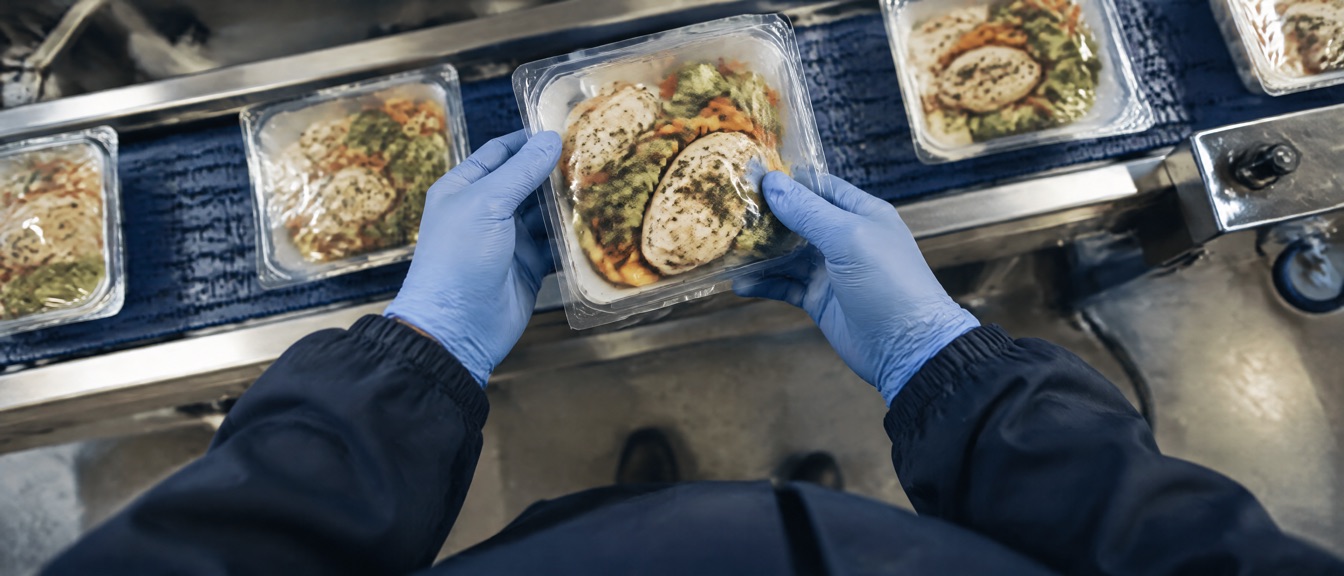
Food plants are now a main driver of US robot demand: the IFR credited the 2025 rebound in US robot installations to the food industry and other non-manufacturing sectors. Chef Robotics' meal assembly robots have made more than 80 million servings and are rented with no upfront cost, and Tyson planned $1.3 billion of automation aimed mainly at chicken deboning. Soft, variable products like raw meat remain hard for robots.
- Packing, palletizing and portioning into trays are the most automated food tasks. Cutting and deboning remain largely manual.
- Robots-as-a-service is common in food: Chef Robotics charges a service fee with no upfront capital.
- Meat varies in size and shape and deforms when handled, which a 2025 research review calls a core limit on automation.
What are robots doing in food processing in 2026?
At the end of the line, a lot. Robots stack cases on pallets, pick packs into cartons and, newer, place food into trays. Chef Robotics' arms portion ingredients into ready meals for frozen and fresh brands and, by the time it launched its Chef+ model, had made more than 80 million servings in production.
At the start of the line it is harder. Tyson said in 2021 it would spend $1.3 billion over three years to automate parts of its processing, cutting more than 3,000 jobs through 2024, mostly deboning roles in chicken plants. Red meat cutting and trimming remain mostly done by skilled hands.
| Company or type | Robot and task | Status | Source |
|---|---|---|---|
| Chef Robotics | AI-guided arms placing ingredients into meal trays | Deployed, robots-as-a-service | The Robot Report |
| Tyson Foods | Automated chicken deboning and processing lines | Deployed from 2021 investment | KCUR |
| Food and consumer goods plants | Packing, picking and palletizing | Deployed, growing | A3 |
| Red meat cutting and trimming | Robot cutting of variable carcasses | Research and early systems | Frontiers review |
How much does food processing automation cost?
There is no standard price. Large processors invest in custom lines at enormous scale; Tyson's 2021 plan alone was $1.3 billion. Smaller plants increasingly rent. Chef Robotics, for example, sells its meal assembly robots as a service with no upfront capital investment, so the cost shows up as a monthly fee rather than a purchase.
When you price it, include washdown and sanitation design, changeover time between products and the people you still need to feed, check and clean the robot. A robot that cannot handle your product mix without long changeovers can cost more than the labor it replaces.
How fast are food plants adopting robots?
Fast, from a low base. The IFR said US industrial robot installations rose 11% to about 38,000 in its preliminary 2025 figures, a recovery it put down to growth in the food industry and other non-manufacturing sectors. A3 reported 36,766 robots ordered in North America in 2025, naming food and consumer goods among the industries driving growth.
The reason is the same everywhere: plants struggle to staff cold, wet, repetitive jobs on every shift.
What can food processing robots still not do?
Handling raw, variable product well. A 2025 review in Frontiers in Robotics and AI says meat processing automation is constrained by equipment sensitivity to size variations and by material deformability, which calls for adaptive robots. Every bird and every cut is a little different, and the knife work depends on feel.
Robots also struggle with frequent recipe changes, delicate items such as pastries and garnishes, and the cleaning and setup work between runs. The IFR says even general-purpose humanoids remain specialized and often need human teleoperation.
Will robots replace food processing workers?
Some roles are shrinking where automation works, as Tyson's deboning plan shows. But most food plants are short of people rather than over-staffed, and the jobs that remain call for skill: trimming, quality checks, sanitation and running the equipment.
For an owner of a bakery, co-packer or small processor, the realistic plan is to automate the end-of-line work where a rented robot fits and to keep and reward the experienced people who do the variable work.
Why robot makers need footage of your crew
The hand skills robots lack in food plants, such as trimming, portioning by eye and handling soft product, are best learned from examples. Figure has shown a humanoid learning from 100% egocentric human video with no robot demonstrations. See how robots learn from video for why first-person footage is in demand.
Amelia Robotics pays businesses for approved recordings of work their crews already do. A phone is mounted so it films the task from the worker's view with the hands in frame, and each worker starts a recording deliberately. Tasks, permitted areas and participants are agreed on a setup call before anyone records, and you can leave out jobs or areas. Payment goes to the business once a month with a statement, and you decide how much to share with the crew.
Illustrative example: a food plant with 12 line workers who each record 15 approved hours a week would earn about $7,200 a month at the typical rate (12 x 15 x 4 x $10). Amelia's typical pay is $500 to $2,000 a month per recording employee, assuming 12.5 to 50 approved hours a week. Earnings vary, and your agreement and approved recordings decide actual pay. See what counts on our food manufacturing page.
Next step
See how food manufacturers get paid for recording work and run your numbers in the calculator.
Common questions
What robots are used in food processing?
Palletizing, case packing and pick-and-place robots are common. Newer systems such as Chef Robotics place ingredients into meal trays, and large poultry plants use automated deboning lines.
How much does a food processing robot cost?
There is no standard price. Many smaller plants now rent: Chef Robotics, for example, offers its robots as a service with no upfront capital investment.
Can robots debone meat?
Partly. Tyson invested $1.3 billion from 2021 mostly in chicken deboning automation, but a 2025 review says variable sizes and soft, deformable product still limit meat automation.
Is food processing automation growing?
Yes. The IFR credited the 2025 rebound in US robot installations to the food industry and other non-manufacturing sectors.
Will robots replace food plant workers?
They are replacing some repetitive roles, but plants remain short of people and the variable, skilled work stays manual for now.
Can a food manufacturer get paid to record its line workers?
Yes. Amelia Robotics lists food manufacturing among its priorities and pays businesses for approved recordings. Its example is $500 to $2,000 a month per recording employee; earnings vary.
Sources and further reading
- IFR: US robot installations, preliminary 2025 (Jun 2026)
- A3: North American robot orders 2025 (Feb 2026)
- The Robot Report: Chef Robotics Chef+
- KCUR: Tyson invests $1.3 billion in automation (2021)
- Frontiers in Robotics and AI: meat processing automation review (2025)
- IFR: World Robotics 2026 service robots (Sep 2026)
- Figure: Project Go-Big, training on human video
- Amelia Robotics: business program (checked Nov 2026)
- Amelia Robotics: for robotics labs
Origin Data Partners is independent. We may be paid by our partner when a business we introduce is paid; it never comes out of your earnings. How Origin is paid.