We found no reliable public average profit margin for independent retail bakeries. The closest benchmark is counter-service restaurants, which kept a median 4.0% of sales before tax in 2024, according to the National Restaurant Association. A bakery's margin depends mostly on ingredient costs, labor hours, waste from unsold goods and how much it sells wholesale.
- No reliable public margin survey covers independent retail bakeries.
- Closest benchmark: counter-service restaurants, 4.0% median pre-tax margin in 2024.
- Industry-wide bakery figures are dominated by large factory bakeries: the 50 largest make about 60% of revenue.
What is the average bakery profit margin?
There is no reliable public figure for independent bakeries. SBDCNet, quoting First Research, describes a US bakery products industry of about 10,000 establishments with about $43 billion in revenue, but the 50 largest companies generate about 60% of it, so industry-wide numbers describe factory bakeries, not a neighborhood shop.
The closest benchmark for a retail bakery or bakery-cafe is the National Restaurant Association survey of limited-service restaurants, which found a median pre-tax income of 4.0% of sales in 2024. Treat it as a reference point, not a target.
What drives a bakery's margin?
SBDCNet says bakery profitability is determined by efficiency of operations. Across restaurants, the National Restaurant Association finds food and labor each take about 33 cents of every sales dollar, and bakeries face the same pressure, with early-morning labor and ingredient prices at the center.
- Ingredient costs: flour, butter, eggs and sugar move with commodity prices.
- Labor hours: bakers earned a 2025 median of $37,160, and production starts hours before opening.
- Waste: unsold goods at closing are pure cost unless discounted or donated.
- Product mix: custom cakes and wholesale accounts carry different margins from the morning counter.
- Rent and ovens: fixed costs that do not shrink on slow days.
What could your crew earn?
Move the sliders to match your crew.
- Per worker
- $500
- You keep
- $4,000
- Per year
- $96,000
Illustrative, at about $10 per approved hour. Typical pay is $500 to $2,000 a month per recording employee; earnings vary and your agreement decides actual pay.
What the benchmark means at different sales levels
Plain arithmetic at the 4.0% counter-service median. Your own margin may be higher or lower:
| Annual sales | Pre-tax profit at 4.0% | Profit per extra 1 point of margin |
|---|---|---|
| $300,000 | $12,000 | $3,000 |
| $600,000 | $24,000 | $6,000 |
| $1,000,000 | $40,000 | $10,000 |
Source: National Restaurant Association: 2025 Restaurant Operations Data Abstract summary (Aug 2025)
How can a bakery improve its margin?
What owners take home is covered in bakery owner salary. The levers on margin:
- Cost every recipe and reprice items whose ingredient cost has crept up.
- Bake to sales history to cut end-of-day waste.
- Grow custom orders, catering and wholesale accounts that are paid in advance.
- Schedule production so ovens run full.
- Add revenue that does not need more counter sales (below).
A new revenue line that uses work your crew already does
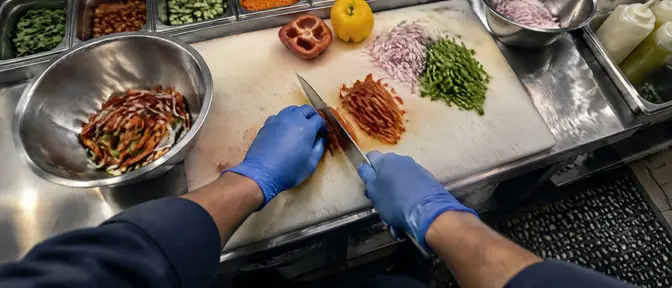
Amelia Robotics lists food manufacturing and commercial kitchens among its priorities and pays businesses for approved first-person recordings of routine work, such as mixing, shaping and decorating, used to train AI and robots. Amelia's typical pay is $500 to $2,000 a month per recording employee, assuming 12.5 to 50 approved hours a week; earnings vary, and your agreement and the approved recordings decide what is actually paid.
Illustrative example for three bakers recording part of their shifts: 3 bakers x 12.5 approved hours a week x 4 weeks x $10 = $1,500 a month, or $18,000 a year, at the typical rate. Amelia pays the business once a month with a statement, and you decide how much to share with the people who record.
At the 4.0% benchmark, $18,000 a year equals the profit on about $450,000 of sales. Results vary and depend on approval. See how this works in commercial kitchens and what food robots do today.
Next step
Estimate your bakery's figure on the Physical AI hub.
Common questions
What is the average profit margin for a bakery?
We found no reliable public average for independent bakeries. The closest benchmark is counter-service restaurants, at a 4.0% median pre-tax margin in 2024 (National Restaurant Association).
Why is it hard to find bakery margin data?
Industry statistics are dominated by large factory bakeries; SBDCNet says the 50 largest companies generate about 60% of bakery products revenue.
What costs the most in a bakery?
Ingredients and labor. Across restaurants, food and labor each take about 33 cents of every sales dollar, and bakers earned a 2025 median of $37,160 (BLS).
How can a bakery be more profitable?
Cost every recipe, bake to sales history to cut waste, and grow prepaid custom and wholesale orders.
Is a bakery a profitable business?
It can be, but SBDCNet notes profitability is determined by efficiency of operations, and margins in counter-service food are thin.
Sources and further reading
- SBDCNet, SBA-funded clearinghouse: Bakery business snapshot (checked Nov 2026)
- National Restaurant Association: 2025 Restaurant Operations Data Abstract summary (Aug 2025)
- National Restaurant Association: Elevated costs continue to pressure restaurant profitability (July 2026)
- O*NET OnLine (BLS 2025 wages): Bakers
- Amelia Robotics: business program (checked Nov 2026)
- Amelia Robotics: for robotics labs
Origin Data Partners is independent. We may be paid by our partner when a business we introduce is paid; it never comes out of your earnings. How Origin is paid.